

August 18, 2026
Ask what the biggest tree in the world is and you will get four confident answers, all of them correct. That is not a trick- it is a measurement problem. A tree can be the largest, the tallest, the widest, or the heaviest, and no single tree holds all four titles.
General Sherman gets named most often, and by the standard forestry definition it deserves the top spot. But it is a hundred feet shorter than the tallest tree alive, its trunk is less than a third the girth of the widest one, and by weight it is not even close to the biggest living thing on the planet.
This is the full ranking. Every record holder, the number that earned it, where the tree stands, and why the categories disagree with each other. Sources are the National Park Service, the U.S. Geological Survey, and Guinness World Records.
The Record Board: Five Giants, Five Different Titles
Here is every major record and who currently holds it.

Two things stand out immediately. Four of the five champions are in the United States, and three of those four are in California. And the trees that win are not the trees most people would guess. A cypress in a Mexican churchyard beats every redwood for width, and a stand of aspen in Utah that looks like an ordinary forest outweighs them all.
Why "Biggest Tree" Has Four Correct Answers
The confusion is not sloppy reporting. Foresters, record keepers, and biologists genuinely measure different things, and each method answers a different question.

A few notes on how these records get set, because the details matter more than you would expect:
-
Volume counts the trunk only. Branches, roots, and foliage are excluded. That is why a tree with a huge crown can still lose to one with a fatter trunk.
-
Height has to be confirmed by tape. Laser estimates are useful for finding candidates, but a world record needs a climber to run a tape from the top down.
-
Girth is the messiest number. A trunk that flares out at the base reads much wider than the tree really is, which is why published figures for the same tree can differ by twenty feet.
-
Mass allows for clones. If thousands of stems share one root system and one set of genes, some definitions count the whole thing as a single organism. That rule change is what puts an aspen at the top.
The Largest Tree in the World: General Sherman
By trunk volume, the standard measure in forestry, the largest tree in the world is General Sherman, a giant sequoia in the Giant Forest of Sequoia National Park, California. Its trunk holds about 52,508 cubic feet of wood.
The tree stands 274.9 feet tall and measures 102.6 feet around at ground level, with a maximum base diameter of 36.5 feet. The trunk alone is estimated at roughly 1,400 tons. The first big branch does not appear until 130 feet up, and that single branch is nearly seven feet thick, larger than most mature trees in the eastern United States.
Age estimates have come down over the years. The most recent National Park Service figure puts General Sherman at about 2,200 years old, which is respectable but not extraordinary for a giant sequoia. Several trees in the same grove are older.
The five largest trees on Earth
All five are giant sequoias, and three of them stand in the same grove.
|
Rank |
Tree |
Trunk volume |
Location |
|---|---|---|---|
|
1 |
General Sherman |
52,508 cu ft |
Giant Forest, Sequoia National Park |
|
2 |
General Grant |
46,608 cu ft |
Grant Grove, Kings Canyon National Park |
|
3 |
The President |
45,148 cu ft |
Giant Forest, Sequoia National Park |
|
4 |
Lincoln |
44,471 cu ft |
Giant Forest, Sequoia National Park |
|
5 |
Stagg |
42,557 cu ft |
Alder Creek Grove, Sierra Nevada |
Sources: National Park Service and U.S. Geological Survey survey data. Volumes measure the bole, or main trunk, only. Most figures predate 2012 and do not include subsequent growth.
These rankings shift over time, and not only because the trees keep growing. A mature giant sequoia adds roughly 40 cubic feet of wood a year, which is about the volume of a 50-foot tree one foot thick. Rankings also change when a tree loses its crown, which is how General Grant moved up a place in 2003.
The Stagg tree is worth a moment on its own. When the Castle Fire tore through Alder Creek Grove in 2020, firefighters set up a sprinkler system around it and saved it. That is the level of individual attention these trees now require.
The Tallest Tree in the World: Hyperion
The tallest tree in the world is Hyperion, a coast redwood in Redwood National Park in northern California, measured at roughly 380 feet. For scale, that is taller than the Statue of Liberty with a school bus parked on top of the torch.
Hyperion was found in 2006 by naturalists Chris Atkins and Michael Taylor in a steep, trailless drainage. Confirming the record meant climbing it and dropping a tape, because laser measurements are not accepted for the official number. The tree is thought to be only 600 to 800 years old, making the tallest tree alive comparatively young.
You cannot go see it. In 2022 the National Park Service closed the area after years of visitors bushwhacking the tree, trampling the understory, compacting the shallow root system, and leaving trash and human waste behind. Entering the closure now risks a fine of up to 5,000 dollars and up to six months in jail.
Tallest tree species in the world
Height is a species trait as much as an individual one. A handful of species can pass 300 feet, and only one reliably passes 350.
|
Species |
Tallest known |
Height |
Where |
|---|---|---|---|
|
Coast redwood |
Hyperion |
About 380 ft |
California |
|
Mountain ash (eucalyptus) |
Centurion |
About 330 ft |
Tasmania, Australia |
|
Yellow meranti |
Menara |
About 323 ft |
Sabah, Borneo |
|
Giant sequoia |
Unnamed specimen |
Up to 311 ft |
California |
|
Douglas fir |
Doerner Fir |
Over 320 ft |
Oregon |
Sources: Guinness World Records and published forestry measurements. Menara was tape-measured at 98.53 m in 2019. Centurion lost its top in 2022, which reduced its height.
Mountain ash and yellow meranti are both notable for a second reason. They are flowering trees, not conifers, which makes Menara and Centurion the tallest hardwoods on record and puts them in a different botanical league from the redwoods above them.
The Widest Tree in the World: El Arbol del Tule
The widest tree in the world is not a redwood at all. It is a Montezuma cypress called El Arbol del Tule, growing in a churchyard in the town of Santa Maria del Tule in Oaxaca, Mexico. It has the thickest trunk ever measured on a living tree.
Published figures for its girth range from about 118 feet to about 138 feet around. That spread is not an error. The trunk is heavily buttressed, folding in and out in deep vertical ridges, so where you place the tape changes the answer substantially. Guinness recorded 118 feet 8 inches in 2005. Local measurements more commonly cite 138 feet.
Either way, the trunk is roughly 46 feet across at its widest. When the town once tried to encircle it by hand, it took about 45 people. The tree is only about 116 feet tall, so the proportions are startling in person: a trunk far wider than the tree is tall in relation to anything else you have seen.
For decades people assumed it had to be several trees fused together. DNA testing settled it. El Arbol del Tule is a single individual, somewhere between 1,400 and 2,000 years old, and it is now a protected natural monument.
The Heaviest Living Thing on Earth: Pando
Drive past Fish Lake in Utah's Fishlake National Forest and you will see what looks like an ordinary aspen grove. It is one tree. Pando, Latin for "I spread," is a single male quaking aspen with roughly 47,000 trunks growing from one connected root system, every stem genetically identical to every other.

The colony covers about 106 acres and weighs an estimated 6,500 tons, roughly ten times the aboveground mass of General Sherman and about the same as 40 blue whales. By weight and by land area, it is the largest known tree and the heaviest known organism on Earth.
Its age is genuinely unsettled. Individual stems live around 130 years, but the root system underneath is far older, with estimates running from several thousand years to tens of thousands. Nobody can date it precisely, because there is no single trunk to core.
Pando is also in trouble. Mule deer and cattle browse the young shoots faster than the colony can replace them, so new stems rarely reach maturity. Researchers at Utah State University have documented the decline, and fencing and restoration work are underway on the Fishlake National Forest to give the young growth a chance.
The Biggest Tree Ever Recorded
Every tree on this list is the biggest one still standing. The biggest trees ever to exist were cut down before anyone measured them properly.
The best documented case is the Crannell Creek Giant, a coast redwood felled in the mid-1940s near Trinidad, California. Based on the records that survive, it is estimated to have been 15 to 25 percent larger by volume than General Sherman. If it were alive today, the world's largest tree would be a redwood on the coast, not a sequoia in the mountains.
That tree was not unusual. Roughly 95 percent of old-growth coast redwood forest was logged during the 1800s and 1900s, and the biggest, straightest, most accessible trees went first. The giants we protect now are the survivors of a much larger population, not the peak of it.
Giant sequoias fared better, and for an unglamorous reason. Their wood is brittle. Loggers found that felled sequoias often shattered on impact, wasting most of the trunk, so the industry largely moved on to species that paid better. Bad lumber saved the species.
What Is the Strongest Tree in the World?
"Strongest" is the one superlative with no official record, because strength means at least three different things. Here is how each one shakes out.
|
Definition |
The winner |
What it means |
|---|---|---|
|
Hardest wood |
Australian buloke |
Commonly cited at about 5,060 lbf on the Janka scale, against 1,290 for red oak and 67 for balsa |
|
Most fire resistant |
Giant sequoia |
Bark up to two feet thick, low in resin, and loaded with tannin that resists burning and rot |
|
Most wind resistant |
Coast redwood |
Shallow roots that interlock with neighboring trees, spreading load across the whole stand |
Note: Janka hardness measures resistance to denting, not overall structural strength, and published values vary with sample, moisture, and test method.
The practical answer for anyone asking about the giants is the second row. A giant sequoia's defense is not hardness. It is insulation and chemistry. The bark chars on the outside while the living tissue underneath stays cool, and the tannin that gives the wood its red color also makes it deeply unappealing to insects and fungi.
Where Are the Biggest Trees in the United States?
The biggest tree in America is the same as the biggest tree in the world. General Sherman holds both titles, which is why searches for the biggest tree in North America, the United States, and the world all land in the same place.
If you want to stand next to genuine record holders, four destinations cover almost all of them:
-
Sequoia National Park, California. Giant Forest holds General Sherman, the President, and Lincoln. Three of the five largest trees on Earth are within walking distance of each other, and the Sherman trail is paved.
-
Kings Canyon National Park, California. Grant Grove holds General Grant, the second largest tree in the world and the only living thing designated a national shrine, in memory of American war dead.
-
Redwood National and State Parks, California. Home to Hyperion, Helios, and Icarus, the three tallest trees known. None are marked, and Hyperion's grove is closed, but the accessible groves hold trees over 350 feet.
-
Fishlake National Forest, Utah. Pando is here, and unlike the others you can walk right into it. Most visitors never realize the grove around them is a single organism.
Yosemite National Park deserves a mention too. Mariposa Grove is the northernmost of the famous sequoia groves and holds the Grizzly Giant, one of the oldest and most photographed sequoias anywhere.
Why Do Trees Grow This Big in the First Place?
Extreme size is not common, and it is not an accident. It takes a narrow set of conditions holding steady for a very long time.
-
Water that does not quit. Sierra snowmelt for sequoias, Pacific fog for redwoods. Both species sit where the dry season is short or softened.
-
No hard freeze and no killing drought. Mild coastal and montane climates let growth continue for most of the year without the setbacks that stall trees elsewhere.
-
Defenses that buy centuries. Tannin-rich wood resists rot and insects. Thick bark blunts fire. A tree that cannot be killed easily has time to get large.
-
The ability to keep growing. These species never really stop. Most trees slow sharply with age. A 2,000-year-old sequoia is still adding wood at close to peak rate.
-
Somewhere to put the weight. Wide, shallow root plates spread across an acre or more, holding up thousands of tons without a taproot.
Take away any one of these and the ceiling drops. That is why the giants are clustered in a few small regions rather than spread across the continent.
What It Takes to Keep the Giants Standing
Nearly every tree in this article is under active management, and several are in measurable decline. Wildfires in 2020 and 2021 killed an estimated 13 to 19 percent of all large giant sequoias on Earth, as many as 14,000 trees, in two seasons. Pando is losing its young growth to browsing. El Arbol del Tule has struggled with road traffic and a falling water table.
The work of supporting the trees looks less dramatic than the trees themselves do: Prescribed burns clear fuel, fencing keeps deer off new shoots, closing trails protect delicate root systems. And, where fire burned so hot that nothing is left to reseed the ground, planting new trees are by hand.
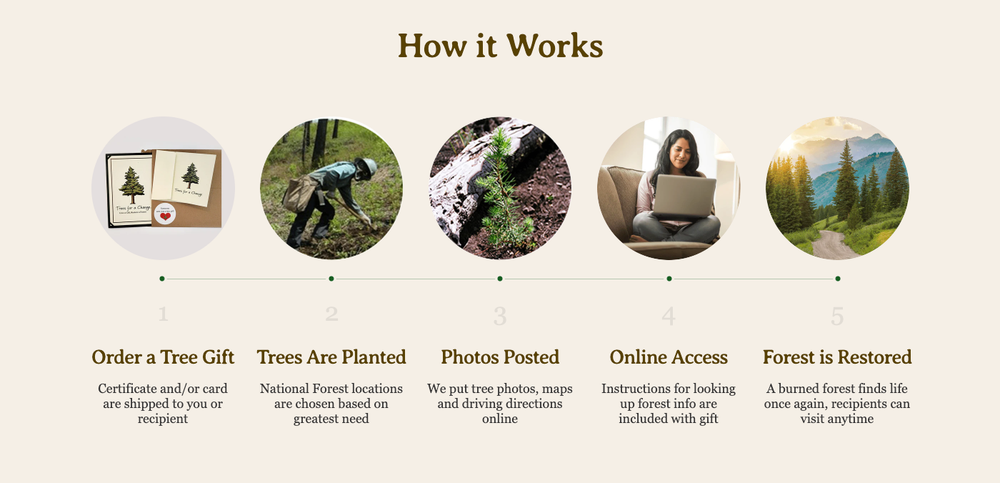
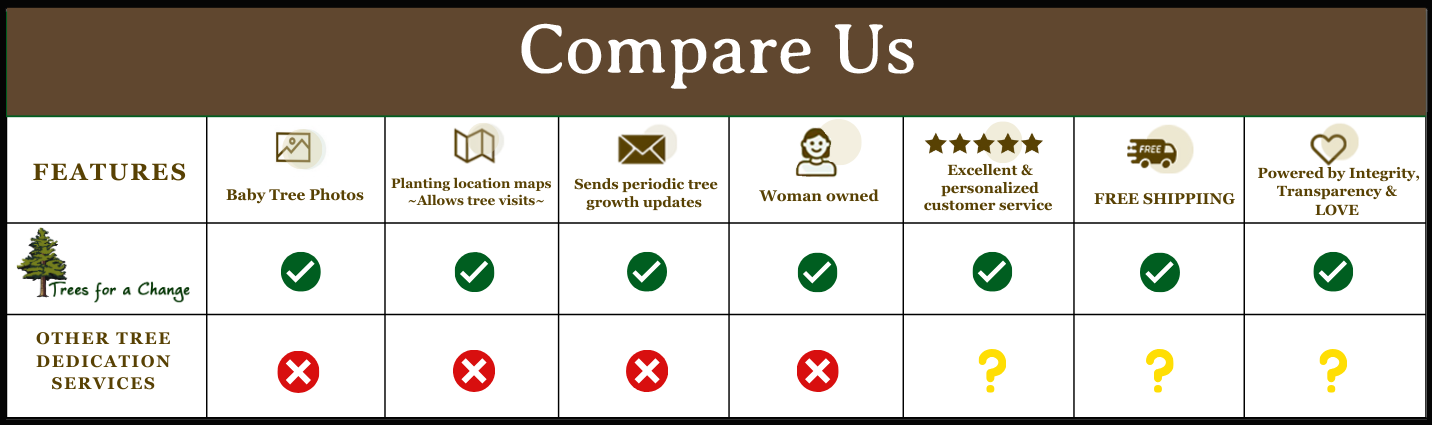
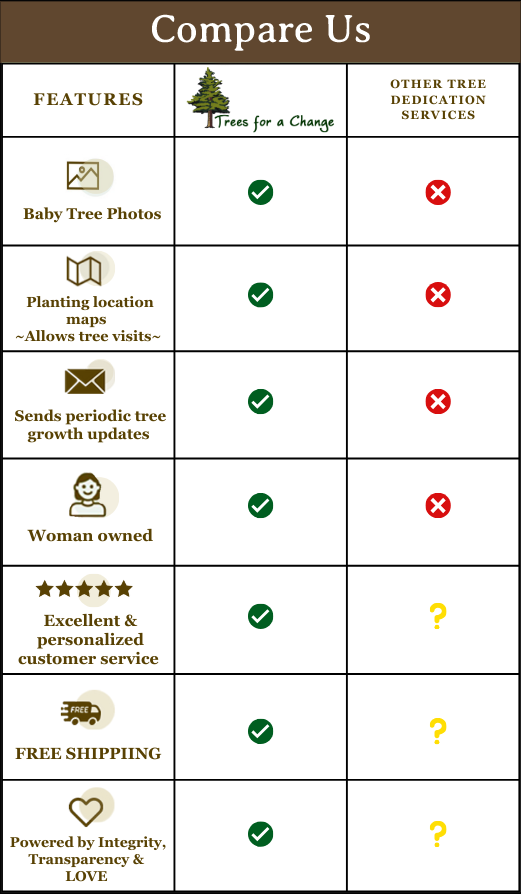
That last piece is where the public gets involved: many people plant trees as a gift with Trees for a Change for special occasions, and those trees go to National Forest land that has been identified as needing restoration. Trees for a Change has planted more than 240,000 trees in these areas since 2007, including Giant Sequoia.
Families can also choose trees for memorial gifts because a growing tree in a recovering forest marks a life in a way that lasts much longer than flowers do. For anyone who has lost a dog or a cat, planting a tree as pet sympathy gift ideas give a real place to put a grief.
None of these tree gifts will produce a new record holder anytime soon, as nothing planted this year will rival General Sherman for two thousand years, but every giant once started out as a seedling.
Frequently Asked Questions
What is the biggest tree in the world?
General Sherman, a giant sequoia in Sequoia National Park, California. Its trunk contains about 52,508 cubic feet of wood, more than any other single-stem tree on Earth.
What is the tallest tree in the world?
Hyperion, a coastal redwood in Redwood National Park, California, standing at roughly 380 feet. Its exact location is not published and the surrounding area is closed to visitors.
What is the widest tree in the world?
El Arbol del Tule, a Montezuma cypress in Oaxaca, Mexico. Its trunk measures between about 118 and 138 feet around depending on how the buttressed base is measured, and roughly 46 feet across.
What is the largest living organism on Earth?
Pando, a quaking aspen colony in Utah made up of about 47,000 stems sharing one root system. It covers 106 acres and weighs an estimated 6,500 tons, making it the heaviest known organism.
What is the biggest tree ever recorded?
The Crannell Creek Giant, a coast redwood cut down in the mid-1940s in northern California, is estimated to have been 15 to 25 percent larger by volume than General Sherman.
Which tree species grows the largest?
The giant sequoia produces the largest trees by volume, and the coast redwood produces the tallest. Both are native only to California, and neither reproduces in the wild anywhere else.
How big is the biggest tree trunk in the world?
El Arbol del Tule has the thickest trunk of any living tree, roughly 46 feet in diameter. General Sherman has the largest trunk by volume, at 36.5 feet across the base and 102.6 feet around.
Where is the biggest tree in America?
In the Giant Forest of Sequoia National Park, California. General Sherman is both the largest tree in the United States and the largest in the world, reached by a paved half-mile trail.
What is the strongest tree in the world?
It depends on the definition. Australian buloke produces the hardest measured wood, while the giant sequoia is the most fire resistant thanks to bark up to two feet thick.
Are the biggest trees in the world protected?
Most are, but protection has limits. Nearly all giant sequoia groves sit in parks or national forests, and thousands of large sequoias still died in the 2020 and 2021 wildfires.
The Bottom Line
The biggest tree in the world is General Sherman if you mean volume, Hyperion if you mean height, El Arbol del Tule if you mean width, and Pando if you mean sheer living weight. All four answers are right, and knowing which question you are asking is most of the work.
If you want to see them, start with Giant Forest in Sequoia National Park. Three of the five largest trees on Earth are there, the trails are paved, and no photograph has ever done the scale justice. Go on a weekday morning, and give yourself longer than you planned.
What sticks with most people afterward is not the statistics. It is standing at the base of something that was already ancient when the Roman Empire was young, and doing the arithmetic on what it has outlived. These trees are still here. Whether the next generation of them gets the same chance is being decided right now.