

August 13, 2026
Almost everyone has seen a photo of a car driving through a tunnel cut in a tree trunk. Fewer people can say whether that tree was a sequoia or a redwood, where it grows, or why a tree that size exists at all. The two names get swapped constantly, even in guidebooks and news stories.
They are not the same tree. Giant sequoias and coast redwoods are cousins that split off long ago and settled into two very different corners of California. One went wide. The other went tall. Both ended up holding world records, and both are now in more trouble than most people realize.
This guide covers what these trees are, where sequoias and redwoods grow, how big they actually get, how long they live, and why fire is both the thing that keeps their forests healthy and the thing currently killing them by the thousands. No botany degree required.
Sequoia or Redwood? Start With This
If you only read one section, read this one. Here is the short version, side by side.

The fast version, in plain terms:
-
Giant sequoia is the bulkiest. It has the most wood in its trunk of any tree alive. Thick, columnar, and built like a grain silo.
-
Coast redwood is the tallest. It grows like a mast, narrow and impossibly high, in the fog belt along the Pacific.
-
They live in different places. Sequoias grow in the Sierra Nevada mountains. Redwoods grow near the ocean. Their ranges never touch.
-
Both are called redwoods. That is where the confusion starts. "Redwood" is a family nickname, not a single species.
-
Neither one grows wild anywhere else on Earth. Outside a few narrow strips of California and Oregon, every sequoia and redwood you see was planted by a person.
What Is a Giant Sequoia?
A giant sequoia is a massive evergreen conifer in the cypress family, known to science as Sequoiadendron giganteum. It is the largest tree on Earth measured by the volume of wood in its trunk. Not the tallest and not the oldest, but by sheer bulk nothing else comes close.
A mature giant sequoia typically stands somewhere between 165 and 280 feet tall with a trunk 20 to 26 feet across. The trunk barely tapers as it rises, which is a big part of why these trees hold so much wood. Most trees narrow quickly. A sequoia keeps going up like a column.
The tree goes by several names, and they all describe the same species. You may see it called the Sierra redwood, the giant redwood, or simply the big tree. The genus name honors Sequoyah, the Cherokee scholar who created the Cherokee writing system.
Where giant sequoias grow
The natural range of the giant sequoia is remarkably small. Every wild grove sits on the western slope of California's Sierra Nevada, in a broken belt roughly 260 miles long and rarely more than 15 miles wide. Botanists count somewhere between 70 and 81 groves depending on how they draw the boundaries, covering only about 29,000 to 36,000 acres in total.
They grow at elevation, generally between 4,000 and 8,000 feet, where winters bring deep snow and summers run dry. That snowmelt matters. A large sequoia can move hundreds of gallons of water a day, and the Sierra snowpack is what feeds it.
The most visited groves are easy to name. Giant Forest in Sequoia National Park holds General Sherman. Grant Grove in Kings Canyon National Park holds the General Grant tree. Mariposa Grove in Yosemite National Park is the northernmost of the famous three.
How to recognize a giant sequoia
Once you know what to look for, a sequoia is hard to mistake for anything else:
-
The bark. Spongy, deeply furrowed, and cinnamon red. On old trees it can reach two feet thick. Press it and it gives, more like cork than wood.
-
The shape. A thick column with no branches for the first 100 feet or more, then a rounded crown that looks small for the trunk holding it up.
-
The leaves. Tiny, scale-like, and pressed close to the twig, more like a cedar than a pine. They spiral around the branch instead of lying flat.
-
The cones. Barrel shaped and about the size of a chicken egg, which is comically small for a tree this size.
What Is a Coast Redwood?
A coast redwood, Sequoia sempervirens, is the tallest tree species on the planet. The scientific name means roughly "forever living," which is a fair description of a tree that regrows from its own stump after being cut. It is often called the California redwood or simply the coastal redwood.
Where a sequoia is built wide, a redwood is built narrow and high. Trunks run about 6 to 20 feet across, which is enormous by any normal standard and still slender compared to a sequoia. What redwoods do is climb. Dozens of individuals in northern California clear 350 feet.
Where coast redwoods grow
Coast redwoods live in a narrow coastal strip that runs from the Big Sur area of central California north into the very southwest corner of Oregon. The band is usually only 5 to 35 miles wide and hugs the coastline. Step inland past the reach of the marine air and the redwoods stop.
Old-growth redwood forest is now rare. Roughly 95 percent of the original old-growth was logged during the 1800s and 1900s, and what remains is concentrated in protected parks such as Redwood National and State Parks, Humboldt Redwoods State Park, and Muir Woods just north of San Francisco.
Why coast redwoods grow so tall
Fog is the short answer. Summer fog rolls in off the Pacific and settles into these valleys, cutting water loss and letting the trees drink through their foliage as well as their roots. That extra moisture during the dry season is what allows a redwood to keep pushing water to a crown 35 stories up.
There is a physical ceiling to this. Pulling water that high against gravity gets harder the taller the tree gets, which is why researchers estimate the practical limit for a redwood sits somewhere around 400 feet. Hyperion, the current record holder, is already close.
The Third Redwood Hardly Anyone Knows
The redwood family has a third living member, and it is the strangest of the group. The dawn redwood, Metasequoia glyptostroboides, was known only from fossils and assumed extinct until living stands turned up in central China in the 1940s.
Two things make it unusual. It is far smaller than its California cousins, topping out around 150 feet. And it is deciduous, meaning it drops its needles every fall and stands bare through winter. A conifer that goes naked in October surprises almost everyone who plants one.
Dawn redwoods now grow in parks and yards across much of the world, largely because seed was distributed widely after the rediscovery. If you have seen a redwood outside of California, there is a decent chance this was it.
How Big Do Sequoias and Redwoods Actually Get?
Photographs flatten these trees. Numbers help, but the numbers are hard to hold onto without something familiar next to them.

Here are the record holders and what makes each one notable.
|
Tree |
Species |
Size |
Why it matters |
|---|---|---|---|
|
General Sherman |
Giant sequoia |
275 ft tall |
Largest tree on Earth by trunk volume at about 52,500 cubic feet |
|
Hyperion |
Coast redwood |
About 380 ft |
Tallest known living tree anywhere in the world |
|
General Grant |
Giant sequoia |
268 ft tall |
Widest trunk at chest height of any sequoia, nearly 29 feet |
|
Helios |
Coast redwood |
About 377 ft |
Second tallest tree, in the same park as Hyperion |
|
President |
Giant sequoia |
241 ft tall |
Ranks second by volume and is still adding wood at speed |
Sources: National Park Service, Sequoia and Kings Canyon National Parks; Guinness World Records. Heights are remeasured periodically and shift slightly over time.
A few comparisons that tend to stick: General Sherman weighs an estimated 2,000 tons, which is roughly 400 elephants. Its trunk holds enough wood to frame more than 100 average houses. The first major branch on that tree starts 130 feet up and is itself nearly seven feet thick, bigger than most full-grown trees east of the Mississippi.
Hyperion, for its part, stands taller than the Statue of Liberty with a school bus set on top. You cannot visit it. The National Park Service closed the area around the tree in 2022 after years of off-trail traffic damaged the ground and root system, and entering the closure now carries a fine of up to 5,000 dollars and possible jail time.
How Long Do Sequoia Trees Live?
Giant sequoias routinely pass 2,000 years. The oldest one ever dated by counting rings was somewhere between 3,200 and 3,270 years old. General Sherman, by the most recent National Park Service estimate, is around 2,200 years old, which makes it middle aged for its species.
Coast redwoods live long too, though not quite as long. Most old-growth individuals fall in the 600 to 2,000 year range. Hyperion is thought to be only 600 to 800 years old, meaning the tallest tree in the world is still relatively young and still growing.
It is worth clearing up a common myth. Sequoias are not the oldest living things on Earth. Great Basin bristlecone pines beat them by a wide margin, and several clonal organisms are older still. What sets sequoias apart is not age alone. It is the combination of extreme age and extreme size in the same organism.
These trees also rarely die of old age. Disease and insects barely touch them, thanks to tannins in the wood and bark that resist rot and pests. When a mature sequoia finally goes down, the usual cause is toppling, as the shallow root system loses its grip in saturated soil.
Built for Fire: Bark, Cones, and a Forest That Needs to Burn
This is the part that surprises people most: Sequoia groves are not merely fire tolerant, they depend on fire to reproduce. Fire scars preserved in tree rings show that low-intensity fires swept through these sequoia forests every 6 to 35 years for at least the last 2,000 years.

The tree comes equipped for it:
-
Bark that will not burn well. Sequoia bark is thick, fibrous, and low in resin. It chars on the outside and insulates the living tissue underneath. A fire that levels a pine forest often just blackens a sequoia.
-
Cones that wait for heat. Sequoia cones can stay closed and green on the branch for up to 20 years. Hot air rising from a fire dries them out and pops them open, releasing seed at exactly the right moment.
-
Seeds that need bare ground. A sequoia seed is about the size of an oat flake and cannot fight through deep forest litter. Fire clears the duff down to mineral soil and gives that seed a place to land.
-
A canopy gap for light. Burning out the smaller firs and cedars underneath opens a hole in the canopy. Sequoia seedlings need full sun, so that gap is the difference between sprouting and surviving.
So a healthy sequoia grove is a burned grove. Take fire away and the system stalls: the litter piles up, shade-tolerant firs crowd in underneath, cones stay shut, and almost no new sequoias get established.
Why the Giants Are in Trouble Now
For most of the last century, fire was suppressed across the Sierra Nevada as a matter of policy. Every small fire was put out. That sounded protective and it was not. It let a hundred years of fuel stack up on ground that had been burning off every decade or two for millennia.
Add drought and rising temperatures and the fires that finally arrive no longer behave like the fires these trees evolved with. They burn hotter, climb into the crowns, and kill trees that had already survived dozens of earlier fires. The results over the last decade have been brutal.
|
Fire Incident |
Sequoias Lost |
|---|---|
|
Rough Fire, 2015 |
More than 100 large sequoias were killed |
|
Castle Fire, 2020 |
Killed an estimated 10 to 14 percent of all large giant sequoias in the world in a single fire season |
|
KNP Complex and Windy fires, 2021 |
Killed or fatally damaged another 2,261 to 3,637 large sequoias, roughly 3 to 5 percent of the global population |
|
2015-2021 Fires as a whole |
Resulting damage estimated to be 13 to 19 percent of all large giant sequoias on Earth, as many as 14,000 trees, lost in 6 years of fires. |
Sources: National Park Service; U.S. Geological Survey; U.S. Department of the Interior; IUCN Red List. Mortality figures are estimates and can rise for several years after a fire.
What remains is fewer than 80,000 mature giant sequoias, which is why the species is listed as Endangered on the IUCN Red List.
Read that fourth row again. Close to a fifth of the world's large giant sequoias, trees that had stood since before the Roman Empire, died in a few fire seasons. Coast redwoods face a different but related squeeze, with old growth already reduced to a fraction of its original extent and a warming climate thinning the summer fog they depend on.
There is real hope in the research, though. A 2026 study in Nature Communications found that groves treated with prescribed burns within the previous decade had 77 percent lower odds of losing their sequoias when wildfire arrived. Deliberate, careful fire is the strongest protection anyone has found.
How Burned Groves Come Back, and How People Help
After a high-severity burn, the natural cycle can fail outright. If the fire killed every mature sequoia in a patch, there is no seed source left to reseed it, and a grove that stood for thousands of years can convert to brush and stay that way. That is when replanting by hand becomes the difference between a forest and a scar.
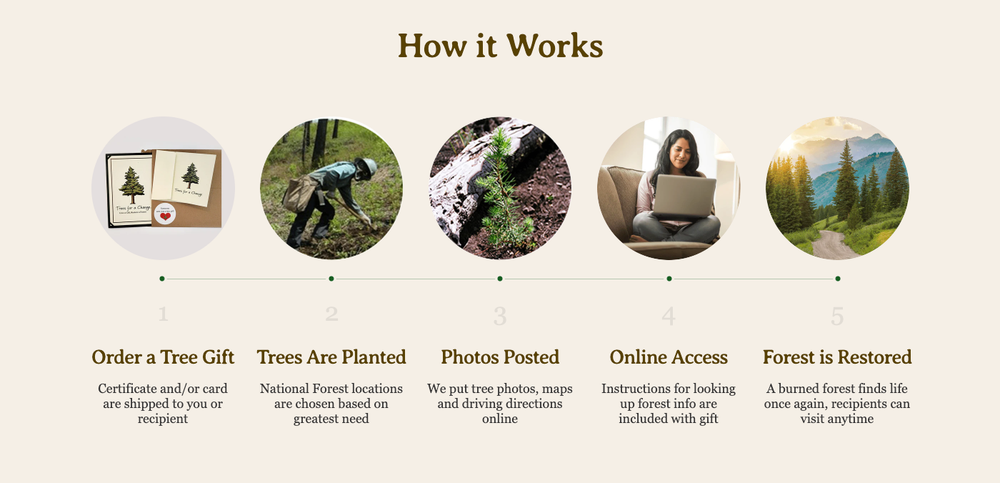
This is the work that desperately needs to happen right now across California's burned National Forest land. Crews collect seed, grow seedlings in nurseries, and plant the seedlings by hand in the areas fire damaged beyond their ability to recover on their own. The problem is, there is very limited federal and state funding for such expensive and painstaking work.
Luckily, ordinary people can help this reforestation effort without ever picking up a shovel. Planting a tree as a gift has become a common way to mark a birthday, a wedding, a new baby, or a special holiday, and each dedicated tree gets planted in a National Forest that has been identified as needing restoration. Trees for a Change has planted almost a quarter of a million trees in these areas since 2007, including Giant Sequoia alongside sugar pine, ponderosa pine, and Jeffrey pine.
Folks can help restore these forests during the harder moments of life as well. Families plant memorial trees in a loved one's name because a living tree in a recovering forest says something a bouquet cannot: this person mattered, and something is growing because they were here. Pet Sympathy Gifts work the same way for the loss of a dog, cat, or horse.
Whatever the occasion, the effect on the ground is the same-a seedling goes in where fire took the forest out, and it starts the long climb back to a lush, thriving forest.
Frequently Asked Questions
What is the difference between a sequoia and a redwood?
Giant sequoias grow in the Sierra Nevada mountains and are the largest trees by volume. Coast redwoods grow along the Pacific coast and are the tallest trees in the world. Both belong to the redwood family, which is why the names get mixed up.
Where do sequoia trees grow naturally?
Wild giant sequoias grow only on the western slopes of California's Sierra Nevada, in roughly 70 to 81 separate groves between about 4,000 and 8,000 feet in elevation. Coast redwoods grow only in the coastal fog belt from central California into southwest Oregon.
What is the biggest tree in the world?
General Sherman, a giant sequoia in Sequoia National Park, is the largest by volume at about 52,500 cubic feet of wood. Hyperion, a coast redwood, is the tallest at roughly 380 feet, though its exact location is closed to visitors.
How old is the oldest sequoia tree?
The oldest giant sequoia ever confirmed by ring count was between 3,200 and 3,270 years old. Most mature sequoias in the famous groves are somewhere between 1,500 and 3,000 years old.
Are giant sequoias endangered?
Yes. The IUCN Red List classifies the giant sequoia as Endangered, with fewer than 80,000 mature trees remaining. Coast redwoods are also listed as Endangered, driven largely by the loss of old-growth forest.
Can sequoia trees grow outside California?
Planted ones can and do. Giant sequoias grow well in the Pacific Northwest, parts of Europe, and New Zealand, and some planted specimens in Britain are already over 100 feet tall. What they do not do is reproduce on their own outside their native range.
What is the state tree of California?
Both of them. California named the redwood its state tree in 1937, then amended the law in 1953 to make clear that the designation covers the coast redwood and the giant sequoia together.
Do sequoia trees really need fire?
They do. Fire opens their cones, clears the forest floor down to bare soil, and lets sunlight reach the ground. Without periodic low-intensity fire, very few new sequoias get established.
How fast do sequoia trees grow?
Faster than most people expect. A young giant sequoia in good conditions can add two to three feet of height a year, and a mature one adds enough wood annually to make a good-sized ordinary tree.
Why are sequoia trees red?
The color comes from tannin in the bark and wood. That same tannin is what makes these trees so resistant to rot, insects, and fire damage.
The Bottom Line
Sequoias and redwoods are two different answers to the same question about how large a living thing can get. One grew wide in the mountains and became the biggest tree on Earth. The other grew tall in the fog and became the highest. Both did it on a sliver of the North American coast and nowhere else, and both have been standing since long before anyone was around to name them.
If you want to see them, the accessible groves are genuinely accessible. Giant Forest, Grant Grove, and Mariposa Grove all have paved trails leading to trees you will not forget, and Muir Woods puts old-growth coast redwoods within an hour of San Francisco. Go early, stay on the trail, and give yourself more time than you think you need.
And if the numbers in the fire section landed hard, they should. These forests are recovering from losses that have no precedent in recorded history, and the recovery is being done seedling by seedling, by hand, in ground that used to hold giants. That work is still underway, and every single tree makes a difference.