

August 20, 2026
California is the only place on Earth where you can stand next to the largest tree in the world and the tallest tree in the world on the same trip. Both live here, and only here, and they live about 200 miles apart in landscapes that have almost nothing in common.
That is the part most visitors get wrong. People plan a trip to see "the big trees" and end up at the wrong end of the state. The giant sequoias are mountain trees. The coast redwoods are ocean trees. Choosing between them, or fitting both into one trip, is the first real decision.
This guide covers where each kind grows, which groves are worth the drive, what makes each destination different, and what recent wildfires have changed on the ground. Access rules at these parks shift with road conditions and season, so confirm current status with the National Park Service or California State Parks before you drive.
California's Two Giant Tree Regions
Before picking a destination, it helps to see why the state has two separate populations of giant trees that never meet.

Coast redwoods live in a thin band along the Pacific, from Big Sur north into the very corner of Oregon, rarely more than 35 miles inland. They run on summer fog. Giant sequoias live in about 75 scattered groves on the western slope of the Sierra Nevada, mostly between 4,000 and 8,000 feet, and they run on snowmelt.
Between the two sits the Central Valley, which grows neither. So a trip to see redwoods near Eureka and a trip to see sequoias near Fresno are two different vacations, roughly six hours of driving apart.
Where to See Giant Sequoias in the Sierra Nevada
Six destinations cover nearly everything worth seeing, and the first two hold most of the record trees.
Giant Forest, Sequoia National Park
This is the headline destination. Giant Forest holds roughly 2,000 mature sequoias including General Sherman, the largest tree in the world by trunk volume, plus the President and Lincoln, third and fourth on the same list. Three of the five largest trees on Earth stand within walking distance of each other.
The Sherman Tree is reached by a paved half-mile trail that descends from the parking area, which means the walk back is uphill. The Congress Trail loops out from there past the President and several dense stands. The Giant Forest Museum at the south end is the best orientation stop in either park.
Grant Grove, Kings Canyon National Park
Grant Grove holds the General Grant tree, second largest in the world, which is also the only living thing designated a national shrine, in memory of American war dead. President Coolidge named it the nation's Christmas tree in 1926, and a ceremony is still held there every December.
The main loop is short, paved, and mostly flat, which makes Grant Grove the most accessible of the famous groves for visitors with mobility limits or small children.
Redwood Mountain Grove, Kings Canyon National Park
Redwood Mountain Grove is the largest giant sequoia grove on the planet, with an estimated 5,500 mature sequoias inside park boundaries. It is also the least visited of the major groves, because access is by dirt road and long trail rather than a paved path.
It took the worst of the 2021 KNP Complex Fire, losing an estimated 974 to 1,574 large sequoias. What is growing there now is genuinely remarkable in a different way: seedlings coming up at thousands per acre across ground that burned to bare soil. Road repairs and access status change, so check before planning a trip around it.
Mariposa Grove, Yosemite National Park
The northernmost of the famous groves and the easiest to combine with a Yosemite Valley trip. Mariposa holds about 500 mature sequoias including the Grizzly Giant, one of the oldest and most photographed sequoias anywhere, and the California Tunnel Tree, cut through in 1895 and still standing.
Access is usually by shuttle from a parking area near the park's south entrance during peak season. Yosemite has used reservation systems for peak periods in recent years, so check current requirements before you go.
Calaveras Big Trees State Park
This is where the world first learned giant sequoias existed. The North Grove was a tourist attraction by the 1850s, and the stump of the Discovery Tree, felled in 1853 to prove to skeptics back east that trees this size were real, is still there. The South Grove is quieter and holds larger trees.
Calaveras sits at a lower elevation than the southern groves and is the most convenient sequoia destination for anyone based in Sacramento or the Bay Area.
Alder Creek Grove
Alder Creek is a 530-acre property in the southern Sierra that was, until recently, the largest privately owned giant sequoia forest in the world. Save the Redwoods League bought it at the end of 2019 for 15.65 million dollars, funded by more than 8,500 donors. It holds 483 sequoias six feet or more in diameter, including the Stagg Tree, fifth largest in the world.
Much of it burned in the 2020 Castle Fire, and it is now an active restoration site where researchers are testing how planted seedlings survive in severely burned ground. Public access is still being developed, so treat it as a place to follow rather than a place to visit today.
|
Grove |
Park |
Difficulty |
What makes it worth the drive |
|---|---|---|---|
|
Giant Forest |
Sequoia NP |
Easy |
General Sherman plus two more of the five largest trees on Earth |
|
Grant Grove |
Kings Canyon NP |
Easiest |
General Grant, second largest, on a short flat paved loop |
|
Redwood Mountain |
Kings Canyon NP |
Hard |
Largest grove on Earth, and the clearest look at fire recovery |
|
Mariposa Grove |
Yosemite NP |
Moderate |
The Grizzly Giant, and easy to pair with Yosemite Valley |
|
Calaveras Big Trees |
State park |
Easy |
Where sequoias were first publicized, closest to the Bay Area |
Sources: National Park Service and California State Parks. Trail difficulty reflects the main route to the principal trees, not the full trail network. Seasonal closures are common at elevation.
Where to See Coast Redwoods on California's Redwood Coast
The redwood parks run up the northern coast, and unlike the sequoia groves they are not clustered. Expect real driving distances between them.

Redwood National and State Parks
A combined federal and state complex near Crescent City and Orick that holds the tallest trees ever measured, including Hyperion, Helios, and Icarus. None of them are marked, and the area around Hyperion has been closed since 2022 with penalties up to a 5,000 dollar fine and six months in jail for entering.
You do not need the record holders. Tall Trees Grove and the Lady Bird Johnson Grove both hold trees over 350 feet, and permits or shuttles are sometimes required for the more sensitive areas.
Humboldt Redwoods State Park and the Avenue of the Giants
The Avenue of the Giants is a 31-mile stretch of old highway running parallel to Highway 101 through continuous old-growth redwood forest. It is the single best drive in redwood country, and you can experience it without hiking a step.
The park also holds Rockefeller Forest, the largest remaining contiguous stand of old-growth coast redwood in the world. If you only have time for one redwood stop in California, this is a strong argument for making it this one.
Jedediah Smith Redwoods State Park
The northernmost of the redwood parks, near the Oregon border, and the one most often described as the most primeval. Stout Grove is compact, dense, and flat, and the Smith River running alongside it is the largest undammed river in the state.
Muir Woods National Monument
The most convenient old-growth redwood forest in California, about 30 minutes north of San Francisco. It is small, it is busy, and it is still worth it if a north coast trip is not realistic.
Muir Woods has required advance parking or shuttle reservations for years, and turning up without one does not work. Book before you drive.
Big Basin Redwoods State Park
California's oldest state park, established in 1902, and the clearest lesson in what fire does to a redwood forest. The 2020 CZU Lightning Complex Fire burned more than 97 percent of the park and destroyed nearly every structure in it.
The ancient trees largely survived. Coast redwood bark can reach a foot thick, and within weeks green shoots were sprouting directly from blackened trunks. The park reopened in July 2022 with limited day-use access by reservation, and trails have been reopening in stages since. Much of the park remains closed, and reservations are required.
|
Park |
Nearest city |
Why go |
|---|---|---|
|
Redwood National and State Parks |
Crescent City |
The tallest trees on Earth, and the largest protected old-growth area |
|
Humboldt Redwoods |
Weott |
The Avenue of the Giants and Rockefeller Forest, the largest old-growth stand left |
|
Jedediah Smith Redwoods |
Crescent City |
Stout Grove, dense and flat, beside the largest undammed river in California |
|
Muir Woods |
San Francisco |
Old growth within an hour of a major airport, reservations required |
|
Big Basin Redwoods |
Boulder Creek |
Fire recovery in progress at the state's oldest park, limited access |
Sources: National Park Service and California State Parks. Reservation requirements and trail access change seasonally and after storms. Confirm before traveling.
What the Groves Are Telling Us Right Now
If you visit the Sierra groves, you will see burned trees. Not a few. Whole slopes of them. Understanding what you are looking at makes the trip better, and the clearest lesson comes from two groves that sat in the same fire and came out completely differently.

The 2021 KNP Complex Fire burned into 16 giant sequoia groves. Redwood Mountain Grove, the largest on Earth, lost between 974 and 1,574 large sequoias. Giant Forest, holding General Sherman, came through with low to moderate effects along two edges and two fallen trees.
The National Park Service attributes the difference largely to prescribed burning history. Giant Forest had decades of deliberate low-intensity fire distributed across most of the grove, which kept fuel loads down. Redwood Mountain's prescribed burns were concentrated in the northern portion, leaving much of it loaded and vulnerable.
That is the whole argument for controlled burning in one comparison. It also explains why you will sometimes arrive to find a grove closed for a planned burn, which is genuinely good news even when it ruins your itinerary.
Where California's Record Trees Are
If you are chasing superlatives specifically, here is where each one stands.
|
Record |
Tree |
Where |
|---|---|---|
|
Largest tree in the world |
General Sherman |
Giant Forest, Sequoia National Park |
|
Tallest tree in the world |
Hyperion |
Redwood National Park, in a closed area |
|
Second largest tree |
General Grant |
Grant Grove, Kings Canyon National Park |
|
Fifth largest tree |
Stagg |
Alder Creek Grove, southern Sierra Nevada |
|
Largest old-growth redwood stand |
Rockefeller Forest |
Humboldt Redwoods State Park |
Sources: National Park Service, Save the Redwoods League, and California State Parks.
Only three of these are trees you can walk up to. General Sherman and General Grant are both on short paved trails. Rockefeller Forest is open to hikers. Hyperion is off limits, and Alder Creek is not yet set up for visitors.
What Is California's State Tree?
Both of them. California named the redwood its official state tree in 1937, but the wording left it unclear which redwood was meant. The legislature settled it in 1953 by amending the law to cover both the coast redwood and the giant sequoia.
California is one of the few states with two official trees, and given that the pair holds the world records for both largest and tallest, the indecision looks less like a mistake than good sense.
When to Go and What to Expect
The two regions have opposite seasons, which is the single most useful planning fact in this guide.
-
Sequoia groves: late spring through early fall. These groves sit at 4,000 to 8,000 feet. Roads including the Generals Highway close or require chains in winter, and Mariposa Grove's shuttle typically runs only in the warm months.
-
Redwood parks: year round, but summer is foggiest. Coastal fog peaks in summer, which is atmospheric for photos and cold for hiking. Spring and fall often bring clearer light and thinner crowds.
-
Book anything that requires a reservation early. Muir Woods parking, Big Basin day use, and Yosemite peak-period entry all fill well ahead. Showing up without one usually means being turned away.
-
Give yourself more time than the mileage suggests. Mountain roads and the Avenue of the Giants are slow by design. Two groves in one day is usually one grove too many.
One more practical note. Photographs of these trees almost never work. The scale that overwhelms you in person flattens into a picture of a brown column. Bring a person into the frame, or accept that the memory will be better than the photo.
How California's Groves Are Being Rebuilt
The state that holds every giant tree record also holds the losses. Wildfires in 2020 and 2021 killed an estimated 13 to 19 percent of all large giant sequoias on Earth, nearly all of them in California. Roughly 95 percent of the original old-growth coast redwood forest was logged more than a century ago.
The response is unglamorous and slow. Prescribed burns to bring fuel loads down. Trail closures where root systems were being compacted. Land purchases like Alder Creek that moved the last major private grove into protection, bringing more than 98 percent of California's giant sequoia groves under public, tribal, or conservation ownership. And in the places that burned hot enough to kill every seed source, planting by hand.
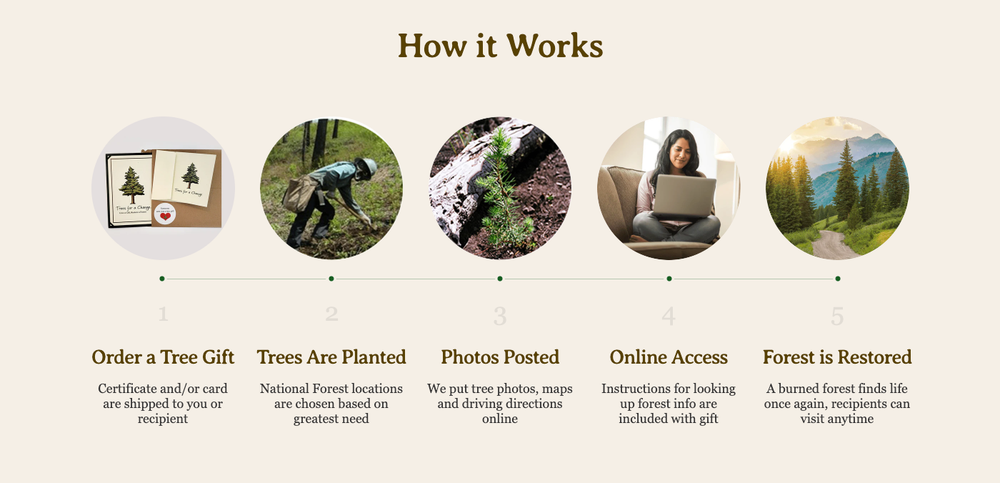
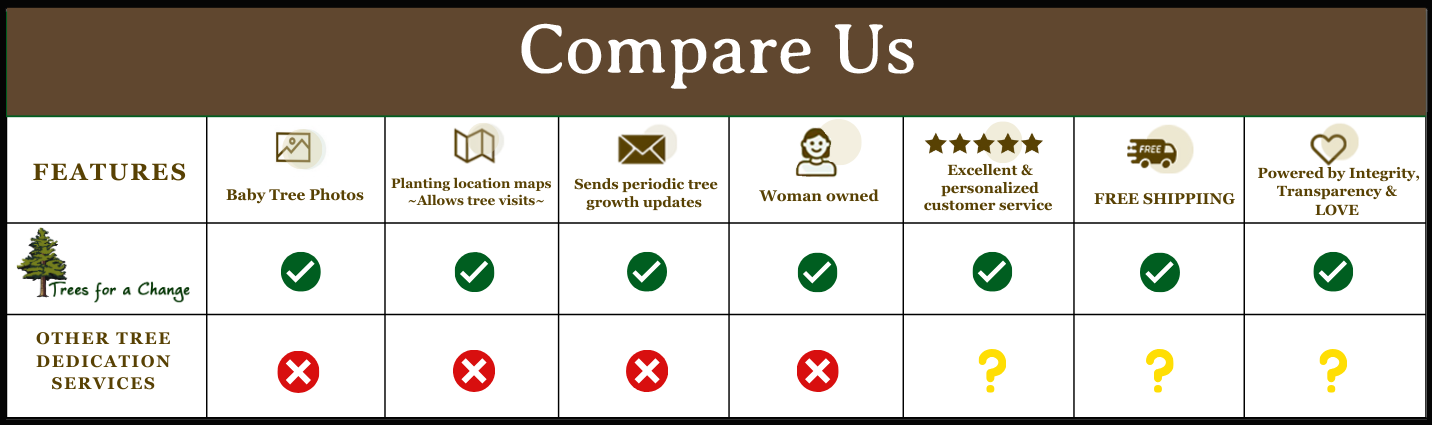
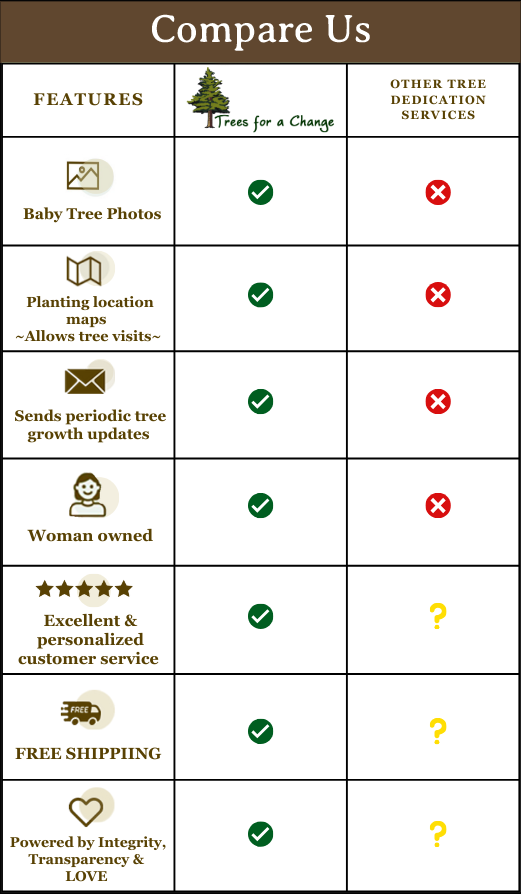
That last category is where the public shows up. A steady number of people are planting trees as a gift for birthdays, weddings, and new babies, and those trees go into National Forest land flagged as needing restoration. Trees for a Change, based in Santa Rosa, has planted more than 243,000 trees in these forests since 2007, Giant Sequoia among the species, in the same mountains the record holders stand in.
The same approach turns up in harder moments. Families use memorial tree planting services to mark a death with something that grows instead of something that wilts, and can be visited later. For a lost dog or cat, pet memorial gifts do the same work for a grief that people often carry quietly.
None of it replaces a 2,000-year-old tree. Nothing does. What it does is keep the ground forested while the next generation gets started, which in these groves is measured in centuries rather than seasons.
Frequently Asked Questions
Where are the biggest trees in California?
In the Giant Forest of Sequoia National Park. It holds General Sherman, the largest tree in the world, along with the President and Lincoln, third and fourth largest, all within a short walk of each other.
Where are the tallest trees in California?
In Redwood National and State Parks on the far north coast. The three tallest known trees on Earth grow there, though none are marked and the area around Hyperion is closed to the public.
What is the difference between California's redwoods and sequoias?
Coast redwoods grow along the ocean and are the tallest trees. Giant sequoias grow in the Sierra Nevada and are the largest by volume. The two ranges are about 200 miles apart and never overlap.
Can you see redwoods and sequoias on the same trip?
Yes, but plan for it. The nearest redwood park to the sequoia groves is roughly six hours of driving. Most visitors pick one region per trip unless they have a full week.
What is the best place to see giant redwoods near San Francisco?
Muir Woods National Monument, about 30 minutes north of the city, holds accessible old-growth coast redwood. Advance parking or shuttle reservations are required.
Is Big Basin Redwoods State Park open?
Partially. The park reopened in July 2022 after the 2020 CZU fire with limited day-use access by reservation, and trails have reopened in stages since. Much of the park remains closed, so check current status before going.
What is the largest grove of sequoias in California?
Redwood Mountain Grove in Kings Canyon National Park, with an estimated 5,500 mature giant sequoias. It is the largest sequoia grove in the world and among the least visited, because access is by dirt road and trail.
Do you need a reservation to see California's big trees?
It depends on the destination. Muir Woods and Big Basin require them, and Yosemite has used peak-period entry reservations. The Sequoia and Kings Canyon groves generally do not, though seasonal road closures apply.
What is the state tree of California?
California has two. The redwood was designated in 1937, and the law was amended in 1953 to include both the coast redwood and the giant sequoia.
Are California's giant trees still dying?
Losses continue, though at a slower pace than the 2020 and 2021 fire seasons. Groves with a history of prescribed burning have fared dramatically better, which is shaping how the parks are managed now.
The Bottom Line
California is the only state where you can see the largest tree on Earth and the tallest tree on Earth, and the practical catch is that they are nowhere near each other. Pick the Sierra for sequoias and the north coast for redwoods, and give each region its own trip if you can.
For a first visit, Giant Forest and Grant Grove together make the strongest single itinerary, because between them they hold the two largest trees in the world on short paved trails. On the coast, Humboldt Redwoods and the Avenue of the Giants deliver more old growth per mile than anywhere else.
Expect to see fire damage, and do not read it as ruin. Some of what looks destroyed is a grove doing exactly what it has done for thousands of years, and some of it is genuine loss that people are now working, seedling by seedling, to undo. Standing in the middle of both at once is the honest version of the experience.