

August 24, 2026
Almost everything written about redwood and sequoia size quotes the record holders. Hyperion at 380 feet. General Sherman at 52,508 cubic feet. Those numbers are real, and they are also a bit like describing human height by citing the tallest person who ever lived.
The tree you will actually stand next to is smaller than that, and still hard to believe. A normal mature coast redwood is roughly the height of a 20-story building. A normal mature giant sequoia has a trunk wider than a two-lane road. Neither one is a record holder.
This guide covers both: typical dimensions and record dimensions, for height, width, weight, roots, and growth rate. It also covers the question underneath all of them, which is why these trees stop where they do instead of continuing forever.
Typical Size vs. Record Size
Start here, because the gap between normal and record is bigger than most people assume.

|
Measurement |
Coast redwood |
Giant sequoia |
|---|---|---|
|
Typical mature height |
200 to 240 feet |
165 to 280 feet |
|
Tallest ever measured |
About 380 feet (Hyperion) |
About 311 feet |
|
Typical trunk diameter |
6 to 20 feet |
20 to 26 feet |
|
Widest measured |
About 27 feet |
About 40 feet at the base |
|
Largest trunk volume |
38,299 cubic feet |
52,508 cubic feet |
|
Typical lifespan |
600 to 2,000 years |
2,000 to 3,000 years |
Sources: National Park Service, U.S. Forest Service, and published measurements by Humboldt State University researchers. Volume figures measure the main trunk only.
The pattern is clear once you see it side by side. Coast redwoods win on height by a wide margin. Giant sequoias win on width and volume by an even wider one. Neither species wins both, and that split is the single most useful fact about their size.
How Tall Do Redwood Trees Get?
The average coast redwood
A mature old-growth coast redwood generally stands between 200 and 240 feet. That is already taller than almost any other tree species on Earth can manage. In the best sites, on flat alluvial ground with reliable fog, plenty of individuals clear 300 feet, and a handful pass 350.
Second-growth redwoods, which is most of what is left, are much shorter simply because they are younger. A 100-year-old redwood in a logged-over forest might be 150 feet. It is not stunted. It is just not finished.
The tallest redwoods ever measured
Hyperion, in Redwood National Park, is the tallest known tree at roughly 380 feet. Helios and Icarus, nearby, are close behind at about 377 and 371 feet. Records at this level move around, both because new trees get found and because the trees keep growing.
The Stratosphere Giant in Humboldt Redwoods illustrates the second point neatly. It measured 368.6 feet when found in 2000, 371.1 feet in 2010, and 372.7 feet in 2013. It lost the world record to Hyperion in 2006 and has simply carried on growing.
One detail from the research is worth knowing if you ever look up at one of these trees. Nearly all the very tall redwoods have multiple tops rather than a single leader. At some point in their long lives the original top died back, probably during a severe drought, and the tree grew replacements.
How Tall Do Giant Sequoias Get?
Giant sequoias typically reach somewhere between 165 and 280 feet. The tallest ever recorded are around 311 feet, including unnamed trees in Redwood Mountain Grove and the South Calaveras Grove.
So the largest tree in the world is roughly 100 feet shorter than the tallest. General Sherman is 274.9 feet, which is a perfectly ordinary height for a big sequoia and nowhere near the species record.
Why sequoias stop shorter than redwoods
Part of it is habitat. Sierra groves are drier and more exposed than the coastal fog belt, and the growing season at 6,000 feet is shorter.
The bigger factor is lightning. Once a sequoia grows past its neighbors, usually somewhere around 275 feet, it becomes the tallest thing on the ridge and starts taking strikes. Most large sequoias have lost their original tops this way, which is why so many old ones have broken, snag-topped crowns instead of a neat point.
The tree responds by putting growth into girth instead. That trade, height traded for bulk over two or three thousand years, is exactly how a sequoia ends up holding more wood than a redwood a hundred feet taller.
Is There a Maximum Height for a Tree?
Yes, and researchers have put a number on it. The limit is not the strength of the wood. It is the difficulty of lifting water.

A tree moves water by evaporation from its leaves, which pulls a continuous column of water up through the trunk. The taller the tree, the harder that pull has to be, because gravity and friction both increase with distance.
In 2004, a team led by George Koch published a study in Nature based on climbing redwoods at Humboldt Redwoods State Park and taking measurements at the top. They found that leaves in the highest crowns are effectively living in permanent drought even when the soil below is soaked. Leaf size shrinks with height, and photosynthesis falls off.
Extrapolating those gradients gave a maximum height of 122 to 130 meters, or about 400 to 427 feet, barring mechanical damage. That is roughly a 35-story building. Hyperion, at 380 feet, is close enough to that ceiling that the tallest trees alive today are probably near the physical limit for any tree on Earth.
How Wide Do Sequoias and Redwoods Get?
Width is where the two species separate most dramatically, and it is also where published numbers get slippery.
A mature coast redwood trunk usually measures 6 to 20 feet across. The widest known are around 26 to 27 feet. A mature giant sequoia typically runs 20 to 26 feet across, and the widest measured base belongs to the General Grant tree at roughly 40 feet. General Sherman measures 36.5 feet across the base and 102.6 feet around at ground level.
Why published widths disagree
Three things make trunk width harder to pin down than it sounds:
-
Where you put the tape. Foresters usually measure diameter at breast height, about four and a half feet up. Base measurements are much larger because these trunks flare outward at the bottom.
-
Buttressing. A heavily flared base inflates a circumference reading without the tree actually holding more wood at that point.
-
Fused trees. Most coast redwoods over about 30,000 cubic feet are ancient fusions of two or more trees grown together. Whether you count that as one trunk or several changes the number substantially.
That last point is why the largest coast redwood is genuinely disputed. Grogan's Fault, found in 2014 by Chris Atkins and Mario Vaden and also called Juggernaut or Spartan, is usually cited as the largest at about 38,299 cubic feet of main trunk. Lost Monarch and Del Norte Titan appear at the top of other lists depending on how their basal stems are counted.
How Much Does a Redwood Tree Weigh?
Nobody weighs these trees directly, so figures are estimates built from volume and wood density. The estimates are still staggering.
General Sherman's trunk alone is put at roughly 1,400 tons. Counting branches, foliage, and roots, the whole tree is commonly estimated at around 2,000 tons, which is in the neighborhood of 400 elephants. A single large coast redwood, being narrower, weighs less but still runs into the hundreds of tons.
For a sense of what that means in lumber terms, General Sherman's trunk is often said to contain enough wood to frame more than 100 average houses. That is the volume of one tree.
The Root System Holding It All Up
Here is the fact that surprises people most. Neither species has a taproot. Nothing runs deep.A giant sequoia's roots generally reach only 6 to 14 feet down even at full size. What they do instead is spread. Lateral roots commonly extend 100 to 150 feet from the trunk, sometimes past 200 feet, so a single mature tree can draw on several acres of soil.

Coast redwoods are similar: roughly 6 to 12 feet deep, spreading 60 to 80 feet outward. Their advantage is that those roots interlock with the roots of neighboring redwoods, so the stand braces itself as a unit rather than each tree standing alone.
Two consequences follow from this. First, it explains why compacted soil around a famous tree is treated as a serious threat, and why parks close trails over it. Second, it explains how these trees usually die. Not from disease, not from age, but from falling over when saturated ground finally lets go of a shallow root plate.
How Fast Do They Grow?
Faster than their age suggests. A young giant sequoia in good conditions can add two to three feet of height a year, reaching around 30 feet by age 10 and passing 100 feet by about 50.
What is more remarkable is that they never really slow down. A mature giant sequoia adds roughly 40 cubic feet of wood a year, which is about the volume of an entire 50-foot tree a foot thick. A 2,000-year-old sequoia is still one of the fastest accumulating organisms on the planet by annual mass.
That matters for the record books. General Sherman is measurably larger today than when it was first surveyed, and the published rankings, most of which rest on surveys from 2012 or earlier, are already out of date by a few hundred cubic feet per tree.
The Smallest Part: Cones and Seeds
For all the size, the reproductive parts of these trees are almost comically small.
A giant sequoia cone is barrel shaped and roughly the size of a chicken egg, about two to three inches long. Coast redwood cones are smaller still, around an inch. The seeds inside are about the size of an oat flake, and it takes many thousands of them to weigh a pound.
So the largest living thing on Earth starts from something you could lose in the palm of your hand. Sequoia cones can also stay closed and green on the branch for up to 20 years, waiting for the heat of a fire to dry them open.
Growing the Next Generation
Every dimension in this article took between several centuries and several thousand years to produce. That timescale is worth holding onto, because it explains why the losses of the last few years matter so much.
Wildfires in 2020 and 2021 killed an estimated 13 to 19 percent of all large giant sequoias on Earth. Those were trees at the top of every measurement in this guide, and nothing planted now will match them within any human timeframe. Where fire burned hot enough to destroy the seed source, the ground does not reforest itself at all without help.
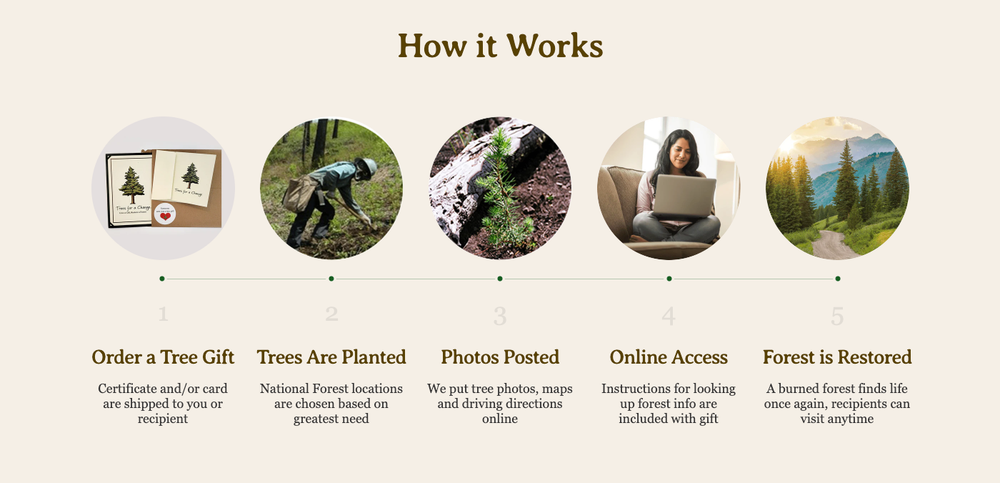
Hand planting is how that gap gets closed, and a good deal of it is paid for by people marking personal occasions. Choosing to plant a real tree as a meaningful gift puts a seedling into National Forest land flagged as needing restoration. Trees for a Change has planted more than 243,000 trees this way since 2007, Giant Sequoia among the species, and posts photos and map locations so the recipient can find theirs.
The same thing carries real weight after a loss. There are trees planted in memory of someone standing in recovering forests right now, each one connected to a name, and they will still be there long after the people who planted them are not. For a dog or cat, sympathy gifts that plant a tree for pets do the same work for a grief that rarely gets much room.
A seedling is a few inches tall and weighs almost nothing. Given a thousand years and the right ground, the numbers at the top of this article are what it turns into.
Frequently Asked Questions
How tall do redwood trees get?
Mature coast redwoods typically reach 200 to 240 feet, with many passing 300 feet in the best sites. The tallest known, Hyperion, stands at about 380 feet.
What is the average height of a redwood tree?
For a mature old-growth coast redwood, roughly 200 to 240 feet. Younger second-growth redwoods are considerably shorter simply because they have not finished growing.
How big are giant sequoia trees?
Typically 165 to 280 feet tall with trunks 20 to 26 feet across. The largest, General Sherman, is 274.9 feet tall, 36.5 feet across at the base, and holds about 52,508 cubic feet of wood.
How wide is a redwood tree?
Mature coast redwood trunks usually measure 6 to 20 feet in diameter, with the widest known around 26 to 27 feet. Giant sequoias are wider, typically 20 to 26 feet, with the widest base close to 40 feet.
How much does a redwood tree weigh?
Estimates rather than measurements. General Sherman's trunk alone is put at about 1,400 tons, and the whole tree at roughly 2,000 tons. Large coast redwoods weigh less, being narrower, but still run to hundreds of tons.
How tall can a redwood tree grow?
Research published in Nature in 2004 estimated a maximum of about 400 to 427 feet, limited by how far a tree can lift water. At 380 feet, the tallest trees alive are already close to that ceiling.
Why are redwood trees so big?
Reliable water, a mild climate with a long growing season, wood that resists rot and insects, and the ability to keep adding mass for thousands of years without slowing down.
How fast do sequoia trees grow?
A young giant sequoia can add two to three feet of height a year, reaching 100 feet by about age 50. Mature trees add roughly 40 cubic feet of wood annually and never really stop.
How big is a sequoia cone?
About the size of a chicken egg, two to three inches long and barrel shaped. Coast redwood cones are smaller, roughly an inch. The seeds inside are about the size of an oat flake.
What is the largest redwood tree in the world?
Among coast redwoods, Grogan's Fault is generally cited as the largest at about 38,299 cubic feet. Rankings are disputed because many large redwoods are ancient fusions of several trees.
The Bottom Line
A typical mature coast redwood stands 200 to 240 feet with a trunk 6 to 20 feet across. A typical mature giant sequoia stands 165 to 280 feet with a trunk 20 to 26 feet across. The records, 380 feet and 52,508 cubic feet, belong to individuals that sit well outside those ranges.
Height has a ceiling of roughly 400 to 427 feet, set by the physics of moving water against gravity. Width and volume have no equivalent limit, which is why a sequoia that stopped growing upward two thousand years ago is still getting bigger every year.
If you want the numbers to mean something, stand at the base of one and look for a person on the far side of the trunk. That is the measurement that actually registers, and it is the reason no photograph of these trees has ever quite worked.