

August 22, 2026
Sequoias and redwoods grow in two of the smallest ranges of any famous tree on Earth. Put together, everywhere they grow wild would fit inside a medium-sized county with room left over. That is a surprising fact about them, and it is why the question of where to find them has such a specific answer.
Most guides answer with a list of parks. That is useful once you are already in California, but it skips the thing people are actually asking when they type where do sequoias grow. They want the range. They want to know why these trees are only in one place, whether any grow closer to home, and what a map of them actually looks like.
This guide covers all of it: the native range of each species with its exact northern and southern limits, a directory of the groves and parks you can visit, the truth about what grows near San Francisco, and where sequoias and redwoods now grow outside California, which turns out to be a much bigger story than most people expect.
The Short Answer: Where Sequoias and Redwoods Grow
Two species, two ranges, no overlap. Here is the whole picture on one map.

The essentials, before the detail:
-
Giant sequoias grow in about 75 groves on the western slope of California's Sierra Nevada, generally between 4,000 and 8,000 feet. Total grove area is only about 29,000 to 36,000 acres.
-
Coast redwoods grow in a strip about 450 miles long and 5 to 35 miles wide, running from the southwest corner of Oregon down to southern Monterey County, California.
-
The two ranges never touch. About 200 miles of Central Valley farmland sits between them, and neither species grows there.
-
Neither reproduces in the wild anywhere else on Earth. Every sequoia or redwood outside these two bands was planted by a person.
-
Most of both ranges is protected. More than 98 percent of giant sequoia groves are in public, tribal, or conservation ownership, and most surviving old-growth redwood is in national or state parks.
Where Giant Sequoias Grow
The giant sequoia has one of the most restricted ranges of any well-known tree. Everything comes down to a single strip of one mountain range.
A range you could drive past in an afternoon
Wild giant sequoias grow only on the western slope of the Sierra Nevada, in a broken belt roughly 260 miles long that is rarely more than 15 miles wide. Within that belt they do not form continuous forest. They appear in about 75 distinct groves, separated by miles of ordinary mixed conifer woodland.
Grove sizes vary enormously. The largest holds thousands of mature trees across a few thousand acres. The smallest contains six living trees. Add every grove together and the total is roughly 29,000 to 36,000 acres, which is smaller than many single ranches in the American West.
Elevation is the hard constraint. Sequoias sit in a band between about 4,000 and 8,000 feet, higher in the south and lower in the north. Below that band it is too dry in summer. Above it, the growing season is too short.
The northernmost and southernmost groves
The range runs roughly from the American River drainage in Placer County at the north end to Deer Creek Grove in Tulare County at the south. The northern third of the range is thin, holding only a handful of widely separated groves. Nearly all the famous ones, and the overwhelming majority of the big trees, are concentrated in the southern counties of Fresno and Tulare.
That concentration matters more than it sounds. It means a single bad fire season in one part of the southern Sierra can affect a large share of the world population, which is exactly what happened in 2020 and 2021.
Giant Sequoia National Monument
Not every grove is in a national park. Giant Sequoia National Monument was established in 2000 and covers roughly 328,000 acres of Sequoia National Forest, protecting many of the groves that sit outside Sequoia and Kings Canyon National Parks.
Monument groves are generally wilder and far less developed than park groves. Some have marked trails and interpretive signs. Others require a forest road and a map, and a few have no formal access at all. If you are looking at a monument map and cannot find a trailhead, that is often because there is not one.
Where Coast Redwoods Grow
The coast redwood range is longer than the sequoia range but just as narrow, and it is defined by one thing: how far inland the ocean air reaches.
The 450-mile coastal strip
Coast redwoods grow in an irregular band about 450 miles long and 5 to 35 miles wide, hugging the Pacific. They occur from sea level up to about 3,000 feet, though most stands sit between roughly 100 and 2,300 feet.
Summer fog is the reason for the shape of that band. Fog cuts water loss during the dry season and lets the trees absorb moisture through their foliage. Follow a valley inland until the fog stops reaching it and the redwoods stop with it, often within a few miles.
The range covers roughly 2.2 million acres, but old growth is a small fraction of that. About 200,000 acres of old-growth redwood remain, most of it in state and national parks, after roughly 95 percent of the original forest was logged in the 1800s and 1900s.
Where the range stops
The northern limit is two groves on the Chetco River in the Siskiyou Mountains of Curry County, Oregon, about 15 miles north of the California border. Those groves are the only naturally occurring coast redwoods outside California.
The southern limit is a grove in Salmon Creek Canyon in the Santa Lucia Mountains of southern Monterey County, at the far south end of Big Sur. The southernmost stand is a small protected botanical area in Los Padres National Forest. It is unmarked and not open to the public, so treat it as a fact rather than a destination.
The Grove and Park Directory
If the question is where you can actually go, this is the working list, north to south.
|
Location |
Species |
Region |
What you will find |
|---|---|---|---|
|
Jedediah Smith Redwoods |
Coast redwood |
Far north coast |
Stout Grove, dense and flat, near the Oregon border |
|
Redwood National and State Parks |
Coast redwood |
North coast |
The three tallest known trees, though none are marked |
|
Humboldt Redwoods |
Coast redwood |
North coast |
Avenue of the Giants and the largest old-growth stand left |
|
Muir Woods |
Coast redwood |
Bay Area |
Accessible old growth, reservations required |
|
Big Basin Redwoods |
Coast redwood |
Santa Cruz Mtns |
Fire recovery in progress, limited reservation access |
|
Calaveras Big Trees |
Giant sequoia |
North Sierra |
Two groves, the closest sequoias to the Bay Area |
|
Mariposa Grove |
Giant sequoia |
Yosemite |
About 500 mature sequoias including the Grizzly Giant |
|
Grant Grove |
Giant sequoia |
Kings Canyon |
General Grant on a short flat paved loop |
|
Giant Forest |
Giant sequoia |
Sequoia NP |
General Sherman and two more of the five largest trees |
|
Giant Sequoia National Monument |
Giant sequoia |
South Sierra |
Wilder groves outside the parks, variable access |
Sources: National Park Service, U.S. Forest Service, and California State Parks. Reservation rules, road conditions, and seasonal closures change. Confirm current access before traveling.
Are There Giant Sequoias Near San Francisco?
This question gets asked constantly, and the honest answer has two halves.
No wild giant sequoias grow anywhere near San Francisco. The nearest natural grove is Calaveras Big Trees, roughly a three-hour drive east into the Sierra foothills. Anything closer than that is a planted tree, and planted giant sequoias do turn up in Bay Area parks, campuses, and old estate grounds, sometimes at impressive size. They are just not a wild population.
What San Francisco does have, and has in abundance, is coast redwoods. Muir Woods National Monument sits about 30 minutes north across the Golden Gate and holds genuine old growth, though advance parking or shuttle reservations are required. Further south, Big Basin and the Santa Cruz Mountains parks hold more.
So if someone tells you they saw redwoods near San Francisco, they almost certainly did. If they say they saw wild sequoias, they were either in the Sierra or looking at a planted tree.
Where Sequoias and Redwoods Grow Outside California
Here is the part that surprises nearly everyone. The wild range is tiny, but the planted range is enormous, and in one country it dwarfs the native population entirely.

Oregon
Oregon is the only other state with naturally occurring redwoods, and only barely: two groves on the Chetco River in the far southwest corner. Beyond that, both coast redwood and giant sequoia are planted widely in western Oregon and Washington, where the climate suits them well, and forestry researchers there actively study growing them.
The United Kingdom
Britain has more giant sequoias than California does. Researchers from University College London and the Royal Botanic Gardens, Kew, estimated in a 2024 study that around half a million sequoias and coast redwoods now grow across the UK, against fewer than 80,000 mature giant sequoias left in the wild in California.
The reason is Victorian fashion. Seed reached Britain in the 1850s and the trees became a status symbol on country estates, planted in avenues and parkland. Nearly two centuries later they are among the tallest trees in the country. The same study found UK-grown sequoias put on height at rates close to their native range, with the tallest measured at about 180 feet in Scotland, and they are still young by sequoia standards.
It is worth being careful about what this means. A planted population scattered across gardens and estates is not a wild ecosystem, and it does not take the species off the endangered list. What it does show is that the tree itself is adaptable, and that what threatens it in California is the fire regime rather than the climate alone.
Canada and everywhere else
No redwoods or sequoias are native to Canada, but both are planted along coastal British Columbia, where the maritime climate is close enough to work. Beyond that, giant sequoias grow in parks and arboreta across much of Europe, New Zealand, Australia, and parts of Asia, and dawn redwoods, the third member of the family, are now planted worldwide after being rediscovered in China in the 1940s.
Why the Wild Range Is So Small
Both species used to be far more widespread. Fossil evidence shows relatives of these trees across much of the northern hemisphere, including North America and Europe, tens of millions of years ago. What is left today is a remnant.
Three things narrowed it:
-
Climate change over geologic time. As the continent dried and cooled through repeated ice ages, the conditions these trees need survived only in a few sheltered pockets. They did not go extinct so much as retreat.
-
Very specific water requirements. Sequoias need reliable snowmelt. Redwoods need summer fog. Both requirements are met in narrow geographic bands and almost nowhere else on the continent.
-
Logging in the last two centuries. This affected redwoods far more than sequoias. Roughly 95 percent of old-growth coast redwood was cut, shrinking the mature range to fragments even where the species still grows.
The result is two species that are simultaneously spectacular and precarious, holding world records while occupying almost no ground.
How to Read a Sequoia or Redwood Map
Range maps for these trees mislead people in a consistent way, and knowing how saves a wasted drive.
-
A shaded range is not continuous forest. The giant sequoia range shown on most maps is the belt the groves sit inside, not a solid band of sequoias. Most of that shaded area is ordinary forest.
-
A marked grove is not a marked trail. Plenty of groves have no developed access. This is especially true across Giant Sequoia National Monument.
-
Record trees are often deliberately unmapped. Hyperion's location is withheld and its grove is closed. Several other tall redwoods are unmarked for the same reason.
-
Park maps beat range maps for planning. Use National Park Service and California State Parks maps for anything you intend to visit, and treat range maps as background.
Where the Next Generation Is Being Planted
There is one more category of location worth knowing about, and it is one that is actually growing: the places where new trees are going into the ground.
After the 2020 and 2021 fires, large areas of the southern Sierra burned hot enough to kill every mature sequoia, which also destroyed the pinecones needed to restore the area. Left alone, it converts to brush and stays that way, so crews now collect seed, raise seedlings in nurseries, and plant them by hand across the worst-burned ground.
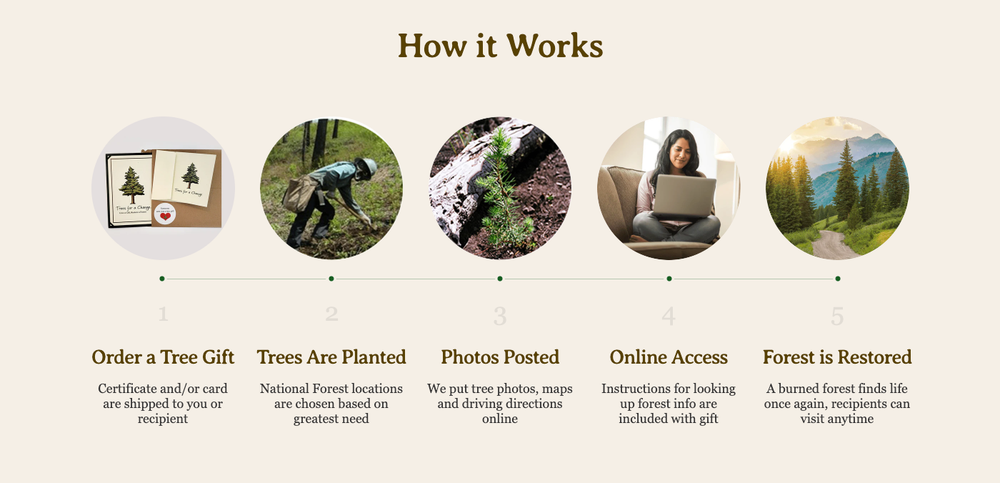
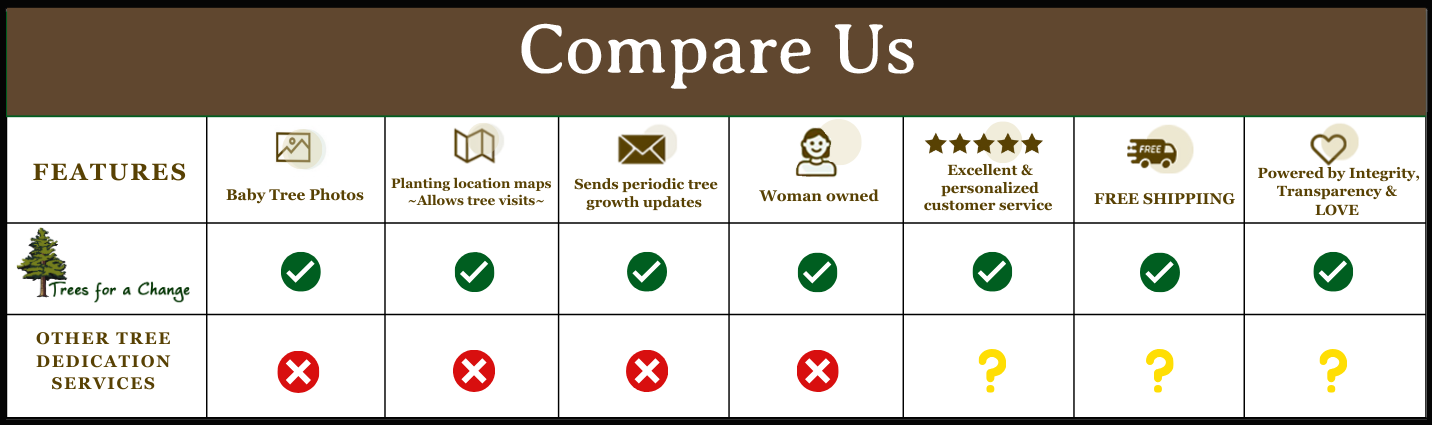
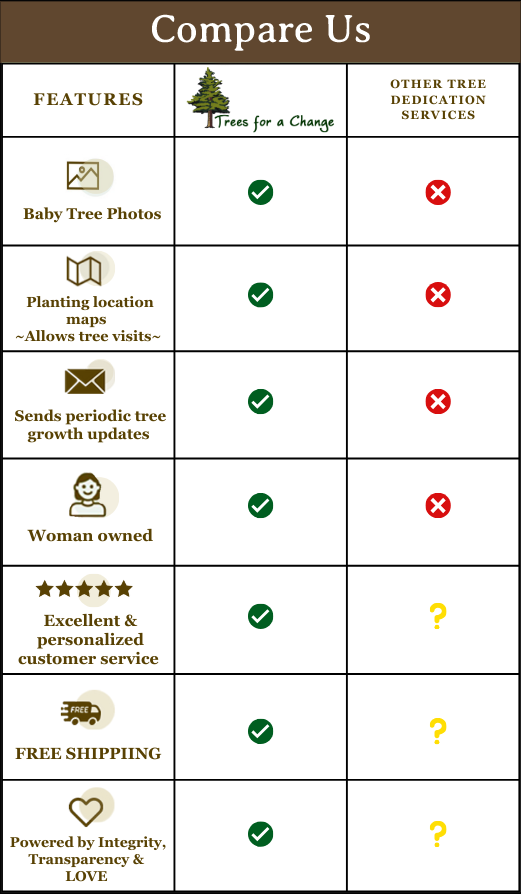
One of the ways that work is funded is by ordinary people marking special occasions. Tree planting as a gift has become a common way to mark a birthday, a wedding, or a new baby, and each dedicated tree goes into a National Forest identified as needing restoration. Trees for a Change has planted more than 243,000 trees in these forests since 2007, Giant Sequoia among the species, and posts photos and locations so recipients can find their tree.
Families can also plant a memorial tree as a gift so there is a living place connected to someone they lost. And pet loss memorial gifts give the same kind of special tribute to people grieving a dog, cat, or horse.
Frequently Asked Questions
Where do giant sequoias grow?
Only on the western slope of California's Sierra Nevada, in about 75 scattered groves between roughly 4,000 and 8,000 feet. They do not grow wild anywhere else on Earth.
Where do redwood trees grow?
Coast redwoods grow in a strip about 450 miles long and 5 to 35 miles wide along the Pacific, from the southwest corner of Oregon south to southern Monterey County, California.
Where can I see sequoia trees?
Giant Forest in Sequoia National Park and Grant Grove in Kings Canyon are the most accessible, both with short paved trails to record trees. Mariposa Grove in Yosemite and Calaveras Big Trees are the next best options.
Are there sequoia trees near San Francisco?
No wild ones. The nearest natural grove is Calaveras Big Trees, about three hours away. Coast redwoods, however, are close: Muir Woods is roughly 30 minutes north of the city.
Do sequoias grow in Oregon?
Coast redwoods grow naturally in two groves on the Chetco River in southwest Oregon. Giant sequoias do not grow wild there, though both species are widely planted across western Oregon.
Are there redwoods in Canada?
None are native. Coast redwoods and giant sequoias have both been planted along coastal British Columbia, where the maritime climate suits them, but there is no wild Canadian population.
Where is the biggest tree in the world located?
General Sherman stands in the Giant Forest of Sequoia National Park, California, reached by a paved half-mile trail. It is the largest tree on Earth by trunk volume.
Where are the tallest trees in the world located?
In Redwood National and State Parks on California's far north coast. The three tallest known trees grow there, and the area around Hyperion, the tallest, has been closed to visitors since 2022.
Is there a map of giant sequoia groves?
Yes. The National Park Service and U.S. Forest Service publish grove maps, including for Giant Sequoia National Monument. Use park maps rather than range maps for trip planning, since range maps show the belt the groves sit in rather than the groves themselves.
How many giant sequoia groves are there?
Counts range from about 70 to 81 depending on how boundaries are drawn. Roughly 75 is the figure most often used, covering a total of about 29,000 to 36,000 acres.
The Bottom Line
Giant sequoias grow in about 75 groves on one slope of one mountain range in California. Coast redwoods grow in a fog-fed strip running 450 miles up the coast into a corner of Oregon. That is the entire wild distribution of both species, and it is startlingly small for trees this famous.
For visiting, the practical shortlist is short: Giant Forest and Grant Grove for sequoias, Humboldt Redwoods and Redwood National and State Parks for the tall coast trees, and Muir Woods if you are near San Francisco and short on time.
The stranger truth is that these trees now grow in far more places than they are native to, and in Britain they outnumber the wild California population several times over. That is worth holding alongside the range map. The species is doing fine as a garden tree. It is the wild groves, in the only place they have ever grown on their own, that need the attention.