



August 30, 2026
Most trees are anonymous, known only by their species. A few dozen have names, and a handful of those have biographies: a discovery date, a list of things done to them, and in several cases an obituary.
These are the trees that ended up on postcards and in schoolbooks. Some are still standing and can be visited on a paved trail. Others were destroyed within a year of being found, by people who wanted to prove to skeptics back east that trees this size existed.
This is a guide to the famous ones, living and gone: what each holds, where it stands, and what happened to the ones that are no longer there.
The Named Giants Still Standing
Six trees account for most of the fame.


General Sherman
The largest tree on Earth by trunk volume, at about 52,508 cubic feet, standing 274.9 feet tall in the Giant Forest of Sequoia National Park. It is roughly 2,200 years old by the most recent Park Service estimate, which makes it middle aged for a sequoia.
It was named for the Union general William Tecumseh Sherman. Before that, a utopian community called the Kaweah Colony had named it the Karl Marx Tree, a detail the Park Service still mentions.
Hyperion
The tallest known tree at roughly 380 feet, found in 2006 by Chris Atkins and Michael Taylor in a steep drainage in Redwood National Park. It is a coast redwood, probably 600 to 800 years old, which makes it young for its species.
You cannot visit it. The Park Service closed the surrounding area in 2022 after years of off-trail traffic damaged the ground and root system, with penalties of up to a 5,000 dollar fine and six months in jail.
General Grant
Second largest in the world at about 46,608 cubic feet, in Grant Grove, Kings Canyon National Park. President Coolidge declared it the nation's Christmas tree in 1926, and it is the only living thing designated a national shrine, in memory of American war dead.
The President and Lincoln
Third and fourth largest, both in the Giant Forest alongside General Sherman. The President is notable for having the densest crown of any sequoia, carrying an estimated two billion leaves, and for still adding wood at a remarkable rate for a tree thought to be around 3,000 years old.
The Grizzly Giant
The most photographed tree in Yosemite, in Mariposa Grove. About 209 feet tall with a volume near 34,005 cubic feet, which puts it around 25th largest, but recent dating places it close to 3,000 years old, making it the oldest tree in its grove. Its enormous lower limb is thicker than most mature trees anywhere else.
If the volume figures are hard to picture, it helps to know what a normal tree of each species measures, because every tree on this list is a statistical outlier rather than a typical example.
The Boole Tree and the Grove That Vanished
The sixth largest giant sequoia has the strangest story of the living trees, and it is worth telling in full.
Converse Basin was once one of the greatest sequoia groves on Earth. Between 1892 and 1918 it was logged of nearly all its mature giant sequoias. Out of thousands, perhaps 60 to 100 large trees survive. Most of the wood shattered on impact and was never used, because sequoia timber is brittle. The stumps are still there, and so are the broken trunks, preserved by tannin.
One tree was left standing. It has the largest base circumference of any sequoia alive, 113 feet around and 36 feet across at the ground, standing 269 feet tall and more than 2,000 years old. Before 1931 it was believed to be the largest tree in the world.
It was named in 1895 for Franklin A. Boole, the man who supervised the logging operation that destroyed everything around it. The story goes that he spared it because of its size. There is little hard evidence for that, and the result is that the biggest survivor of a vanished forest carries the name of the person who oversaw its removal.
Famous Trees That Are No Longer Standing
Five trees are as famous as any on the living list, and none of them exist anymore.

The Discovery Tree, felled 1853
In 1852 a hunter named Augustus Dowd followed a wounded grizzly into what is now the Calaveras North Grove and came back with a story nobody believed. He eventually talked a group into walking twenty miles to see for themselves.
Within a year, speculators cut the tree down. No saw was long enough, so crews drilled through it with long-handled pump augers and wedges, and even then it stood until a breeze pushed it over. A pavilion was built on the stump and used as a dance floor, a newspaper office, and an exhibit hall. Part of the fallen trunk was turned into a bowling alley.
It is still there, known as the Big Stump. The Miwok had known about these trees for centuries before any of this.
Mother of the Forest, killed 1854
The second largest tree in the same grove, roughly 328 feet tall with a girth of 93 feet. In 1854 a group of businessmen built scaffolding around it and had crews strip about 60 tons of bark, in eight-foot sections, up to a height of 116 feet.
The bark was reassembled for paying audiences in New York and later at the Crystal Palace in London. Stripping a sequoia of its bark kills it, and it did. The bare trunk stood for another half century until it burned in the fires of 1908.
John Muir's response is the line most often quoted about it: "skinning this tree alive," he wrote, "is as sensible a scheme as skinning our great men would be to prove their greatness."
The public reaction to what happened to these two trees is generally credited with helping start the American conservation movement. Calaveras Grove became a state park in 1931, seventy-nine years after Dowd walked into it.
The General Noble Tree, cut 1893
Named for a sitting Secretary of the Interior, this tree stood in Converse Basin at more than 285 feet tall with a base circumference of 81 feet, and a ring count put it around 3,200 years old.
It was cut down in 1893, sectioned, shipped to Chicago, and rebuilt at the World's Columbian Exposition to demonstrate that giant sequoias were real. Many visitors refused to believe it and called the exhibit the California hoax.
What remains is the Chicago Stump, about 20 feet high and 26 feet across, reachable by a short loop trail in Giant Sequoia National Monument. It is a strange thing to stand next to: a tree destroyed to prove it existed.
The Wawona Tunnel Tree, fell 1969
The most photographed tree in America for most of a century. In 1881 the Yosemite Stage and Turnpike Company paid two brothers 75 dollars to cut a tunnel through it, enlarging an existing fire scar so stagecoaches could drive through.
It worked as advertising. It also weakened the tree, which was already leaning and leaned further afterward. In February 1969, a heavy snow load brought it down at an estimated 2,100 to 2,300 years old.
The Park Service decided to leave it where it fell, because fallen sequoias become habitat and nursery ground. It is now the Fallen Tunnel Tree, and people still stop to look at it.
The Pioneer Cabin Tree, fell 2017
Calaveras Big Trees had its own tunnel tree, carved in the 1880s specifically to compete with the Wawona. Cars drove through it for decades, then only hikers.
On January 8, 2017, during the strongest storm to hit the area in more than a decade, the ground around it flooded and the tree came down and shattered on impact. It was over 1,000 years old and about 33 feet across.
Both drive-through sequoias are now gone, and the reason is the same in each case. Cutting into a fire scar prevents the tree from healing over the wound, which is exactly what a sequoia would otherwise spend the following centuries doing.
The Biggest Tree Ever Recorded
Every tree on the living list is the biggest one still standing, which is not the same as the biggest that ever stood.
The best documented case is the Crannell Creek Giant, a coast redwood felled in the mid-1940s near Trinidad, California. From surviving records it is estimated to have been 15 to 25 percent larger by volume than General Sherman. Had it survived, the largest tree in the world would be a redwood on the coast rather than a sequoia in the mountains.
The Lindsey Creek tree, said to have blown down in 1905 and often cited as the largest tree ever measured, is a weaker case. The documentation is thin and the figures come from accounts rather than surveys, so treat it as a claim rather than a record.
What is not in dispute is the general point. Roughly 95 percent of old-growth coast redwood was logged, and the biggest and most accessible trees went first. The giants alive today are the survivors of a much larger population, not its peak.
Records That Have Gone from Tree to Tree
Several famous trees are famous mainly for briefly holding a title.
|
Tree |
What it held |
What happened |
|---|---|---|
|
Mendocino Tree |
Tallest known |
Held the title through the late 1990s before being surpassed |
|
Stratosphere Giant |
Tallest known |
Found in 2000 at 368.6 ft, lost the record to Hyperion in 2006, still growing |
|
Washington Tree |
Second largest |
Lost its crown and the hollow upper trunk after a lightning fire in 2003 |
|
Boole Tree |
Largest known |
Believed the largest tree in the world until measurements in 1931 |
|
Grogan's Fault |
Largest coast redwood |
Found in 2014, and the ranking is still disputed because of fused stems |
Sources: National Park Service, published measurements by Humboldt State University researchers, and Guinness World Records. Rankings shift as trees are remeasured, grow, or lose crowns.
The Stratosphere Giant is a useful reminder that these are living things rather than monuments. It measured 368.6 feet when found in 2000, 371.1 feet in 2010, and 372.7 feet in 2013. It lost the world record and simply kept growing.
The Trees Nobody Will Show You
Some of the most significant trees have no signs, no trails, and no published coordinates.
Hyperion's grove is closed outright. The Grove of Titans in Jedediah Smith, which holds several of the largest coast redwoods known, went unmarked for years for the same reason, and a raised boardwalk was eventually built there to keep foot traffic off the root systems. Grogan's Fault, the largest known coast redwood, is not signposted.
The reasoning is unglamorous and sound. These trees have shallow, wide root plates just under the surface. Thousands of people walking to a single tree compacts the soil, kills the understory, and can eventually kill the tree. The Stratosphere Giant's location was withheld from the beginning for exactly this reason.
The trees you can walk right up to are mostly the ones in the developed groves, and knowing which park each of these giants stands in is the practical starting point for seeing any of them in person.
How These Trees Got Their Names
The naming follows a pattern once you notice it. Most of the famous sequoias were named in the late 1800s, and the names come from a narrow set of sources:
-
Civil War generals. Sherman, Grant. The trees were publicized during and just after the war.
-
Presidents and officials. Lincoln, the President, the General Noble Tree, named for a sitting cabinet secretary.
-
The people who found or spared them. The Boole Tree, and Stagg, named for a University of Chicago football coach.
-
Description. The Grizzly Giant, the Telescope Tree, the Fallen Monarch, the Chandelier Tree.
-
Mythology, for the coast redwoods. Hyperion, Helios, Icarus, Daedalus, Iluvatar. These were found much later, mostly by researchers with different reading habits.
Why the Famous Trees Still Need Help
The list of destroyed trees above stops in 2017, which makes it feel like history. It is not.
Wildfires in 2020 and 2021 killed an estimated 13 to 19 percent of all large giant sequoias on Earth, as many as 14,000 trees. Almost none of them had names, but many were the size of the ones that do. The Stagg Tree, fifth largest in the world, survived the 2020 Castle Fire only because firefighters set up a sprinkler system around it.
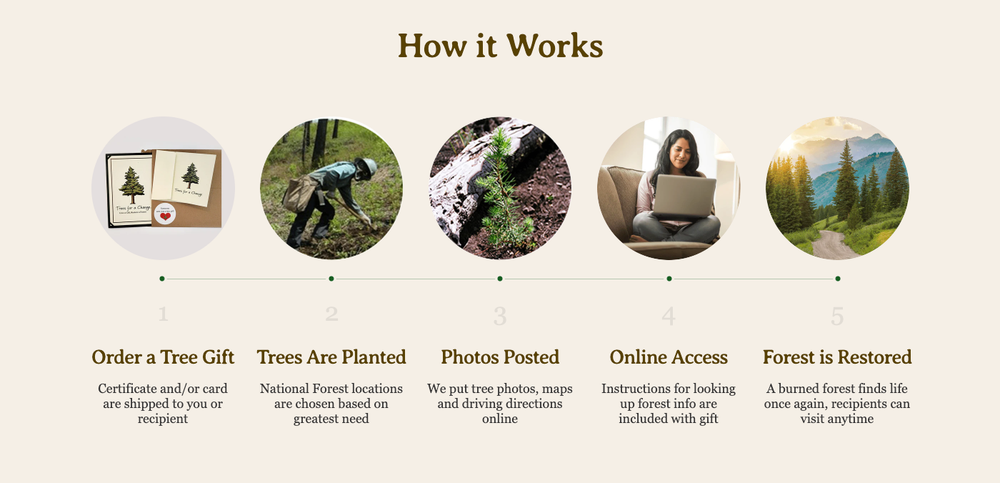
Where fire burns hot enough to kill every mature tree in a patch, the pinecones go with them and the forest does not reforest itself. That is the situation across large areas of National Forest land all across the U.S. right now, and it is why hand planting has become important work.
A good share of that important work is currently funded by reforestation organizations like Trees for a Change. By planting a gift tree in a U.S. forest, ordinary folks can help put a seedlings into areas identified as needing restoration, and Trees for a Change has planted more than 243,000 trees this way since 2007. Species planted over the years have included ponderosa pine, jeffrey pine, incense cedar, douglas fir, and Giant Sequoia to name a few.
Another very special and thoughtful way to contribute to the restoration needs of our National Forests is to have a tree planted for a memorial tribute or as gifts for pet sympathy and remembrance.
Each tree makes a difference now and potentially for thousands of years into the future.
Frequently Asked Questions
What is the most famous tree in the world?
General Sherman, the largest tree on Earth by volume, in Sequoia National Park. Hyperion, the tallest, is arguably as well known but cannot be visited.
What happened to the Wawona Tree?
It fell in February 1969 under a heavy snow load, at roughly 2,100 to 2,300 years old. A tunnel had been cut through it in 1881, which weakened it. It was left where it fell and is now called the Fallen Tunnel Tree.
Can you still drive through a sequoia tree?
No. Both drive-through giant sequoias have fallen, the Wawona in 1969 and the Pioneer Cabin Tree in 2017. Three privately owned coast redwood tunnel trees still allow cars.
What was the Mother of the Forest?
A giant sequoia in the Calaveras North Grove that was stripped of about 60 tons of bark in 1854 so it could be exhibited in New York and London. The stripping killed it, and the remaining trunk burned in 1908.
What is the Chicago Stump?
What is left of the General Noble Tree, cut down in 1893 and rebuilt at the Chicago World's Fair to prove giant sequoias were real. The stump is about 20 feet high and reachable by a short trail.
What is the biggest tree ever recorded?
The best documented is the Crannell Creek Giant, a coast redwood cut in the mid-1940s, estimated at 15 to 25 percent larger by volume than General Sherman.
What is the Stratosphere Giant?
A coastal redwood in Humboldt Redwoods State Park that was the world's tallest known tree from 2000 until Hyperion was found in 2006. It has kept growing and measured 372.7 feet in 2013.
Why is the Boole Tree famous?
It is the sixth largest giant sequoia, has the widest base of any sequoia at 113 feet around, and is the only large tree left standing in Converse Basin after the rest of the grove was logged.
Are the locations of famous trees kept secret?
Some are. Hyperion's grove is closed and several record coast redwoods are unmarked, because concentrated foot traffic compacts their shallow root systems and can kill them.
How old is the oldest famous tree?
Among the named giants, the Grizzly Giant and the President are both estimated to be nearly 3,000 years. The General Noble Tree, cut in 1893, was about 3,200 years old by ring count.
The Bottom Line
The famous trees fall into three groups. The ones you can walk to, like General Sherman, General Grant, and the Grizzly Giant. The ones deliberately hidden, like Hyperion and the largest coast redwoods. And the ones that are gone.
That third group is the one worth sitting with. The Discovery Tree, Mother of the Forest, and the General Noble Tree were all destroyed within forty years of being found, mostly to convince people who had never seen them that they were real. The outrage that followed is a large part of why the rest still exist.
The trees on the living list have outlasted the Roman Empire, the invention of the saw, and the short sighted commercial greed that killed their neighbors.