


Four American national parks contain giant trees, and the names of the parks do an outstanding job of confusing people: Sequoia National Park. Redwood National Park. Kings Canyon, which contains a place called Redwood Canyon. Yosemite, which most people associate with granite rather than trees at all.
The confusion is not the visitor's fault. Both Giant Sequoia and Redwoods get called redwoods, the parks are named inconsistently, and one of the largest giant sequoia groves on Earth sits inside something called Redwood Mountain. People arrive at the wrong park every year expecting the wrong tree.
This guide sorts it out park by park. Which trees are actually within each park, what the biggest tree in each park is, when each park was established, and whether you can reasonably see the sequoia parks and the redwood parks on one trip.
Sequoia National Park and Redwood National Park Are Not the Same Place
They are about 400 miles apart, they hold different species, and they were created 78 years apart for different reasons.

Sequoia National Park, in the southern Sierra Nevada, protects giant sequoias. Redwood National and State Parks, on the far north coast, protects coast redwoods. No national park anywhere holds both species growing wild, because their native ranges never touch.
If it is important to see one species or the other, it is worth understanding what actually separates these two trees before planning a trip, because the difference determines which half of the state you should be driving toward.
Does Sequoia National Park Have Redwoods?
It depends entirely on what you mean by redwood, which is exactly why this question gets asked so often.
Sequoia National Park has no coastal redwoods. Not one. The climate is wrong, the elevation is wrong, and the species has never grown there.
What it does have is giant sequoias, which are members of the redwood family and are frequently called Sierra redwoods or giant redwoods. So a park ranger describing the Giant Forest as a redwood grove is being accurate, and a visitor who came expecting Muir Woods is going to be surprised.
The trees are unmistakably different in person. Coast redwoods are tall and slender with flat, fern-like needles. Giant sequoias are enormous columns with scale-like foliage and bark up to two feet thick. Once you have seen both, you will never confuse them again.
Are There Sequoia Trees in Yosemite?
Yes. Yosemite has three giant sequoia groves, and most visitors drive past all of them on the way to the valley.
There are no coastal redwoods in Yosemite, for the same reasons there are none in Sequoia National Park. Searches for Yosemite redwoods are almost always looking for the giant sequoia groves, which are genuinely there and genuinely worth the detour.
The Biggest Tree in Each Park
Every one of these parks has a champion, and they are measured in different ways.

Two of these are world record holders, and a third is close. For the wider context on how they stack up against every other large tree on the planet, including the widest and heaviest, see how the world's record trees are ranked.
Sequoia National Park
Established September 25, 1890, Sequoia was the second national park in America after Yellowstone, and the first anywhere created specifically to protect a living organism. It was set aside to stop the logging of giant sequoias.
Giant Forest and General Sherman
Giant Forest holds roughly 2,000 mature sequoias, including General Sherman, the largest tree on Earth by trunk volume at about 52,508 cubic feet. The President and Lincoln, third and fourth largest, are in the same grove. Three of the five biggest trees in the world stand within walking distance of each other.
The General Sherman Tree sits at around 6,900 feet of elevation and is reached by a paved half-mile trail that descends from the parking area. Plan for the return walk to be uphill at altitude.
What else is in the park
Moro Rock, a granite dome with a stairway to the summit and a view across the whole southern Sierra. Crescent Meadow, which John Muir called the gem of the Sierra. Tunnel Log, a fallen sequoia cut through so cars can drive under it. Crystal Cave. And on the eastern boundary, Mount Whitney, the highest point in the lower 48.
Kings Canyon National Park
Kings Canyon was established in 1940, absorbing General Grant National Park, which had been created in 1890 just six days after Sequoia. The two parks have been jointly run for decades and function as one destination.
Grant Grove and General Grant
General Grant is the second largest tree in the world at about 46,608 cubic feet, with a ground circumference of 107.6 feet. It is also the only living thing designated a national shrine, in memory of American war dead, and President Coolidge named it the nation's Christmas tree in 1926. A ceremony is still held there each December.
The loop is short, flat, and paved, which makes Grant Grove the most accessible of the great sequoia groves.
Redwood Canyon, which contains no redwoods
This is the single best example of why the naming confuses people. Kings Canyon contains Redwood Canyon and the Redwood Mountain Grove, which is the largest giant sequoia grove on Earth with an estimated 5,500 mature trees inside park boundaries.
There is not one coast redwood in it. The names come from the era when every big red-barked tree in California was simply called a redwood.
The grove took serious damage in the 2021 KNP Complex Fire, losing an estimated 974 to 1,574 large sequoias, and access depends on road repairs. Check current status before planning around it.
Yosemite National Park
Yosemite was established on October 1, 1890, the same week as General Grant National Park. Its sequoias are often treated as a footnote to the valley, which is a mistake.
Mariposa Grove
The largest of Yosemite's three groves, with roughly 500 mature sequoias near the park's south entrance. The best known tree is the Grizzly Giant, about 209 feet tall with a volume near 34,005 cubic feet, which puts it among the 25 or so largest sequoias alive. Recent dating puts it close to 3,000 years old, making it the oldest tree in the grove.
Also here: the California Tunnel Tree, cut through in 1895 and now the only living sequoia with a tunnel, and the fallen Wawona Tunnel Tree, which came down in a storm in 1969. Access is usually by shuttle from the arrival area during peak season.
The grove was threatened by the Washburn Fire in 2022 and came through largely intact, partly because of protective work around the big trees.
Tuolumne and Merced Groves
Both are small, with roughly two dozen mature sequoias each, and both require a hike in and a climb back out. They are far quieter than Mariposa. Merced in particular is the least visited sequoia grove in any national park, which for some visitors is the entire appeal.
Redwood National and State Parks
The unusual one, in almost every respect.
Four parks under one management
Redwood National Park was established October 2, 1968. In 1994, it was combined with three California state parks created in the 1920s: Jedediah Smith, Del Norte Coast, and Prairie Creek. The four are now managed jointly across about 139,000 acres, protecting roughly 45 percent of all remaining old-growth coast redwood forest. The complex has been a UNESCO World Heritage Site since 1980.
That structure matters practically. A trip here means moving between federal and state units with different rules, and some of the best groves, including Stout Grove and the largest known coast redwood, are on the state side.
The tall trees
This is where the height records live. Hyperion, at roughly 380 feet, is the tallest known tree on Earth, with Helios and Icarus close behind. None are marked, and the area around Hyperion has been closed since 2022 with penalties up to a 5,000 dollar fine and six months in jail.
You do not need them. Tall Trees Grove and the Lady Bird Johnson Grove, dedicated by President Nixon in 1969, both hold trees over 350 feet on developed trails.
Beyond the Parks: Monuments and Forests
Not every protected grove is a national park, and the distinction affects what you will find when you arrive.
-
Giant Sequoia National Monument. Roughly 328,000 acres of Sequoia National Forest, managed by the Forest Service rather than the Park Service. Wilder, less developed, and home to many groves outside the parks.
-
Muir Woods National Monument. A small coast redwood grove near San Francisco run by the Park Service. Old growth, easy access, and advance parking or shuttle reservations required.
-
State parks. Calaveras Big Trees for sequoias, and Humboldt Redwoods and Big Basin for coast redwoods. Several hold trees that rival anything in the national parks.
The practical difference is developed access. Park groves generally have paved trails, signs, and rangers. Monument and forest groves often have a dirt road, a trailhead if you are lucky, and no one to ask.
Can You See Both on One Trip?
Technically yes. Realistically, plan two trips.
Sequoia National Park to Redwood National Park is roughly nine to ten hours of driving, and neither is close to a major airport. Adding both to a single itinerary usually means two long travel days and not enough time in either place.
If you have a week and want both, the workable version is to fly into San Francisco, drive north to the redwood coast for several days, then come back down and east into the Sierra. If you have a long weekend, pick one. The sequoia parks are the better choice for record trees on short paved trails. The redwood coast is the better choice for atmosphere and sheer height.
What the Parks Are Doing to Keep the Trees Standing
Every park in this article is managing an active threat. The areas where Sequoia and Redwoods grow are in the middle of ambitious, decades-long restoration efforts, though the threats they face are very different.
In places where Giant Sequoia grow, the enemy is high-intensity wildfire: after the 2020 Castle Fire and the 2021 KNP Complex and Windy fires, nearly 20 percent of all giant sequoias on Earth were killed in just two years, including many of the ancient "monarch" trees. In response, park staff launched emergency actions to remove and reduce dense vegetation and other fire fuels in and around 11 especially at-risk giant sequoia groves, using hand thinning and pile burning. Then they replant new sequoia and other native species seedlings.
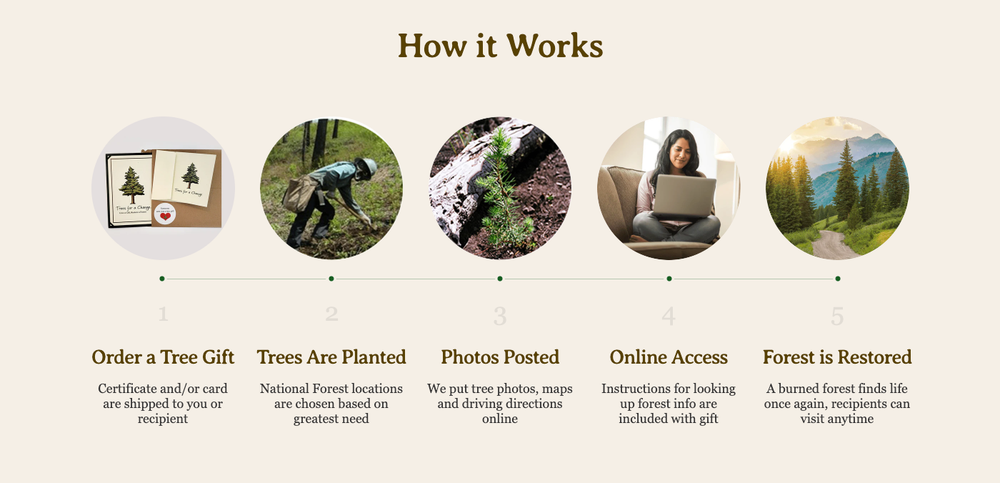
Some of that replanting on public land is done as a result of folks giving the gift of planting trees in national forests which has become a special way to mark a birthday, a wedding, or a retirement. These tree dedications are also a thoughtful gift after a loss. A memorial gift tree planting puts a living tree in a recovering forest rather than a vase of flowers on a table, and the tree can be visited for generations. For a lost dog or cat, memorial tree gifts for pet loss do the same for a grief that people often carry without much acknowledgment.
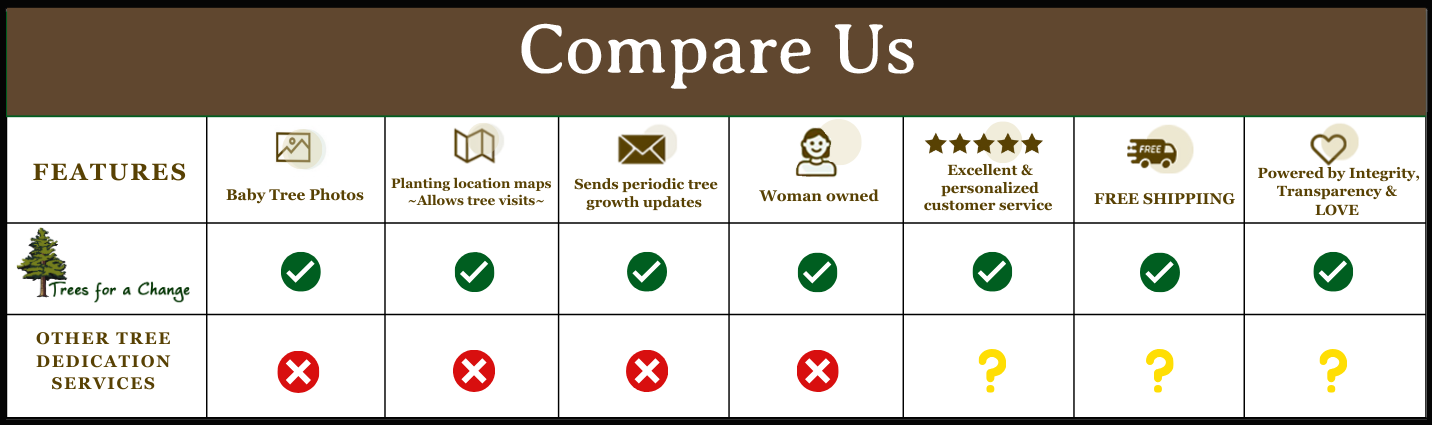
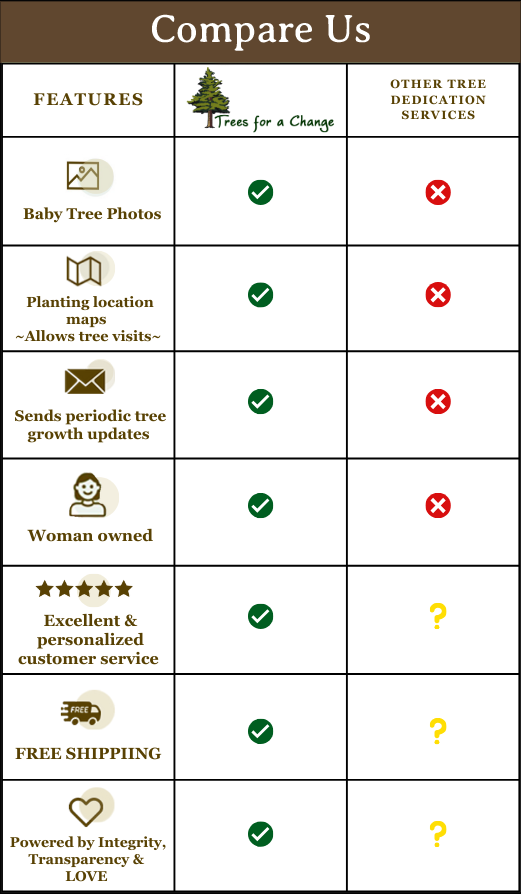
Each dedicated tree that goes into the ground this way is planted in an area needing restoration. Trees for a Change has planted more than 243,000 trees this way including Giant Sequoia, and posts photos and map locations so recipients can visit.
Two hundred miles north where Redwood grow, public lands face the legacy of industrial logging rather than fire. Current tree protection efforts are aimed at restoring more than 70,000 previously logged acres, where a century of clear-cutting left isolated ancient groves surrounded by dense, low-biodiversity regrowth. Efforts include tearing out legacy logging roads, identified as the single biggest threat to the parks' streams and aquatic life, and replanting most haul roads and reshaping natural hillsides.
In both places, the throughline is the same: giving the next generation of trees the room, water, and fire regime they need to become the giants that came before them.
Frequently Asked Questions
Are there redwood trees in Sequoia National Park?
Not coast redwoods. Sequoia National Park holds giant sequoias, which belong to the redwood family and are sometimes called Sierra redwoods. Coast redwoods grow only near the Pacific, about 400 miles away.
Are there sequoia trees in Yosemite National Park?
Yes, in three groves: Mariposa with about 500 mature trees, plus the smaller Tuolumne and Merced groves. There are no coast redwoods in Yosemite.
What is the biggest tree in Sequoia National Park?
General Sherman, in the Giant Forest, at about 52,508 cubic feet of trunk volume and 274.9 feet tall. It is the largest tree on Earth by volume.
What is the biggest tree in Redwood National Park?
By height, Hyperion at roughly 380 feet, though its location is not published and the surrounding area is closed. The largest coastal redwood by volume, Grogan's Fault, is in Jedediah Smith Redwoods State Park within the same complex.
Which is better, Sequoia National Park or Redwood National Park?
They offer different experiences. Sequoia has the largest trees in the world on short paved trails. Redwood has the tallest trees and a coastal setting. If you want a record tree you can walk to easily, choose Sequoia.
How far is Sequoia National Park from Redwood National Park?
Roughly nine to ten hours of driving, about 400 miles apart at opposite ends of California. They are not practical to combine in a short trip.
What is the largest grove of giant sequoias?
Redwood Mountain Grove in Kings Canyon National Park, with an estimated 5,500 mature sequoias. Despite the name, it contains no coastal redwoods.
Is Giant Sequoia National Monument the same as Sequoia National Park?
No. The monument covers about 328,000 acres of Sequoia National Forest and is managed by the Forest Service. The park is managed by the Park Service. Monument groves are generally wilder with less developed access.
When was Sequoia National Park established?
September 25, 1890, making it the second national park in America and the first created specifically to protect a living organism.
Which national park has the oldest trees?
Among the giant tree parks, Yosemite's Grizzly Giant is close to 3,000 years old, and several trees in Sequoia and Kings Canyon are in the same range. The oldest known sequoia ever dated was over 3,200 years.
The Bottom Line
Sequoia, Kings Canyon, and Yosemite hold giant sequoias in the Sierra Nevada. Redwood National and State Parks holds coastal redwoods on the north coast. No park has both, and the places with redwood in the name are not always the ones with coast redwoods in them.
For the biggest trees on the easiest trails, go to Giant Forest and Grant Grove. For the tallest trees and the most atmospheric forest, go to the redwood coast. For sequoias without the crowds, Yosemite's Tuolumne and Merced groves are the quiet answer.
Whichever you choose, expect to see fire scars in the Sierra and stumps on the coast. Both are part of the story these parks are now telling, and both are the reason the protection work described above is still going on.
We plant trees for all occasions
Real trees in U.S. National Forests, with maps, photos and growth updates.