


The short answer is that all sequoias are redwoods, but not all redwoods are sequoias. That sounds like a riddle and it is actually just a family tree.
The longer answer matters because people book flights based on it. Every year visitors arrive at one end of California expecting the trees from the other end, and the naming is genuinely to blame.
This guide answers the three questions people actually ask: are they the same tree, which one is bigger, and how do you tell them apart when you are standing in front of one.
Are Redwoods and Sequoias the Same Thing?
No, but they are close relatives, and the word redwood is doing two jobs at once.
Redwood is a family nickname. It covers three living species that share a subfamily: the coast redwood, the giant sequoia, and the dawn redwood. So a giant sequoia genuinely is a redwood.
Sequoia is narrower. In everyday use it means the giant sequoia, Sequoiadendron giganteum, the mountain tree from the Sierra Nevada. Confusingly, Sequoia with a capital S is also the genus name belonging to the coast redwood, Sequoia sempervirens.
So when someone says redwood, they almost always mean the coast redwood. When someone says sequoia, they almost always mean the giant sequoia. They are two different species that grow about 200 miles apart and never meet in the wild.
Which Is Bigger, a Redwood or a Sequoia?
This is the most searched question about the pair, and the reason it feels unresolvable is that "bigger" means at least three different things.

By volume, the sequoia wins
Trunk volume is the standard forestry measure of largest. General Sherman, a giant sequoia, holds about 52,508 cubic feet. The largest known coast redwood holds around 38,299. A sequoia trunk barely narrows as it rises, which is where all that extra wood lives.
By height, the redwood wins
Hyperion, a coast redwood, stands at roughly 380 feet. The tallest giant sequoias ever measured reach about 311 feet. That is nearly 70 feet of daylight between them, and it is a species difference rather than a fluke.
Sequoias stop shorter partly because their groves are drier and more exposed, and partly because once one grows past its neighbors it starts taking lightning strikes. Many old sequoias have lost their original crowns that way.
By trunk width, the sequoia wins again
A giant sequoia base can reach about 40 feet across. The widest coast redwoods run around 26 to 27 feet. In person this is the most obvious difference of the three, and it is why sequoia photographs so often include a person for scale.
So both species hold a real world record. Sequoias are the largest trees on Earth. Redwoods are the tallest. Anyone who tells you only one of those is correct is answering a different question than the one you asked.
How to Tell Them Apart in Front of You
If you are looking at an actual tree, or a photograph of one, four checks will settle it in under a minute.

Look at the needles first
This is the fastest and most reliable check. Giant sequoia foliage is made of tiny, sharp, blue-green scales that spiral around the twig, closer to a juniper than a pine. Coast redwood needles are flat, deep green, and arranged in two rows along the stem, so a spray looks like a fern frond.
One nuance that trips people up: coast redwoods carry two leaf types. High in the crown the needles get shorter and more scale-like, which can look sequoia-ish. Judge from the lower branches where the flat sprays are unmistakable.
Look at the cones
Giant sequoia cones are egg-shaped, two to three inches long, and often still green because they can stay sealed on the branch for up to twenty years waiting for fire. Coast redwood cones are round and under an inch, sitting at the branch tips and very easy to walk past on the ground.
Look at the base of the trunk
A sequoia base is a fluted cinnamon column with bark up to two feet thick, and it stays enormous as it rises. A coast redwood is slimmer and tapers steadily. Old coast redwoods often weather to grey or charcoal under moss and lichen, so the red is not always obvious.
Then there is the single most conclusive sign in the whole guide: coast redwoods resprout from burls and from the base of a fallen or cut tree, producing a ring of young trunks around the old one. These are called fairy rings. Giant sequoias do not do this. If you see a circle of trunks around a stump, you are on the coast.
Look at the ground you are standing on
This is another clue: coast redwoods grow in damp coastal forest with a dense understory of ferns that hides the base of the trunk, usually with fog somewhere overhead. Giant sequoias grow on drier mountain slopes above 4,000 feet, with open ground around the base that gives you a clear view of the trunk.
If you can see the whole bottom of the tree without pushing through ferns, and you drove uphill to get there, it is a sequoia.
Trees That Are Not Redwoods But Look Like Them
Several California conifers get mistaken for both, usually because of size and reddish bark.
-
Incense-cedar. Scale-like leaves pressed flat to the twig and long narrow cones. Crush the foliage and it smells like a freshly sharpened pencil.
-
Douglas-fir. Tall, straight and cinnamon-barked. Its cones have distinctive three-pointed bracts sticking out between the scales, which nothing else has.
-
Ponderosa pine. Big reddish trunks with bark that breaks into jigsaw-piece plates, needles in bundles of three, and ordinary woody pine cones.
The general rule is that redwood bark is thick, fibrous and spongy enough to press with a thumb. If the bark is hard, plated or flaky, it is not a redwood.
The Third Redwood Nobody Mentions
Every redwood versus sequoia debate leaves out the dawn redwood, Metasequoia glyptostroboides, which is the strangest of the three.
It was described from fossils and assumed extinct until living trees turned up in central China in the 1940s. It is much smaller than its California cousins, and it is deciduous, dropping its needles every autumn after turning russet.
Two identification keys: the needles sit in matched opposite pairs rather than alternating, and the tree is bare in winter. If you find a redwood-looking conifer with no foliage in January, in a park rather than a forest, that is a dawn redwood.
Which One Should You Go See?
They deliver completely different experiences, so this is a real choice rather than a ranking.
|
If you want |
Go to |
Because |
|---|---|---|
|
Record trees on easy trails |
Sequoia and Kings Canyon National Parks |
The two largest trees on Earth sit on short paved loops |
|
Atmosphere and sheer height |
The north coast redwood parks in California |
Fog, ferns, and trees over 350 feet in dense old growth |
|
A short trip from a city |
Muir Woods |
Genuine old-growth redwood about 30 minutes from San Francisco |
|
Solitude |
Yosemite's smaller groves |
Tuolumne and Merced hold sequoias with a fraction of the visitors |
Sources: National Park Service and California State Parks. Reservation requirements and seasonal access vary by site.
Which One Should You Plant?
If you are choosing a tree for a property rather than a trip, the answer is usually the giant sequoia, and the reason is climate tolerance.
Giant sequoia grows reliably in USDA zones 6 through 8, with hardy cultivars proven into zone 5. Coast redwood needs the mild, moist, fog-influenced conditions of a maritime climate and does poorly away from them. Sequoia also handles neutral to slightly alkaline soil better.
Either way, the constraint is space rather than difficulty, and what it takes to raise one from seed is worth reading before buying anything, because the root spread of a mature tree exceeds most residential lots.
Why the Names Are So Confusing
The muddle is historical, not botanical. Both trees were publicized during the Gold Rush era, when any enormous red-barked California conifer was simply called a redwood.
It got worse from there. The giant sequoia was formally named four separate times before 1939, and one of the rejected names, Sequoia gigantea, put it in the same genus as the coast redwood for decades. Britain still calls it a Wellingtonia. California named the redwood its state tree in 1937 without specifying which one, and had to amend the law in 1953 to cover both.
Sorting the naming out is most of the battle, and everything else worth knowing about these two trees follows more easily once the vocabulary is straight.
Planting Either One Where It Belongs
One difference between the two species matters more than any of the identification keys, and it is about what has happened to them.
Coast redwoods were logged. Roughly 95 percent of the original old-growth forest was cut, which is why the surviving groves are precious fragments in protected parks. Giant sequoias mostly escaped logging because their wood is brittle and shattered on felling, but they are now losing ground to fire. An estimated 13 to 19 percent of all large giant sequoias on Earth were lost to wildfire in 2020-2021 alone.
Both species are listed as endangered. Both are being replanted where the damage has been severe enough that natural regeneration will not happen on its own.
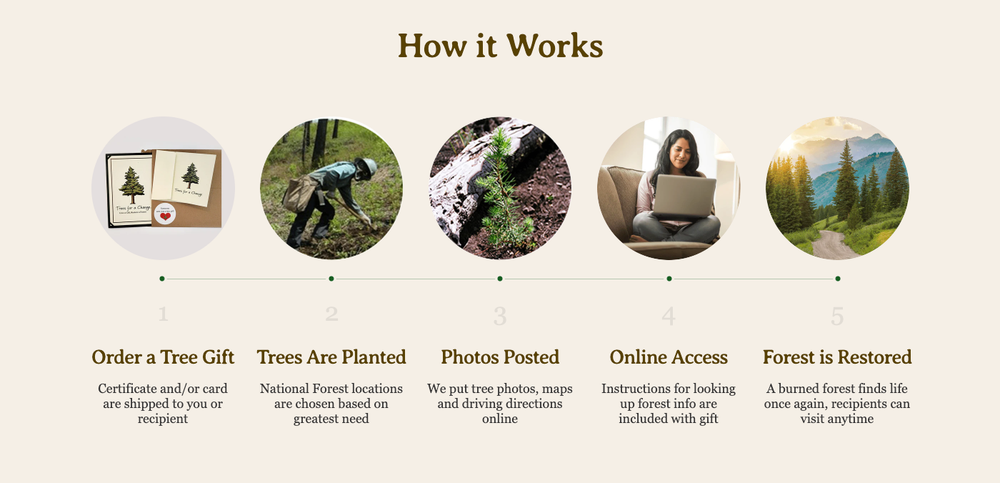
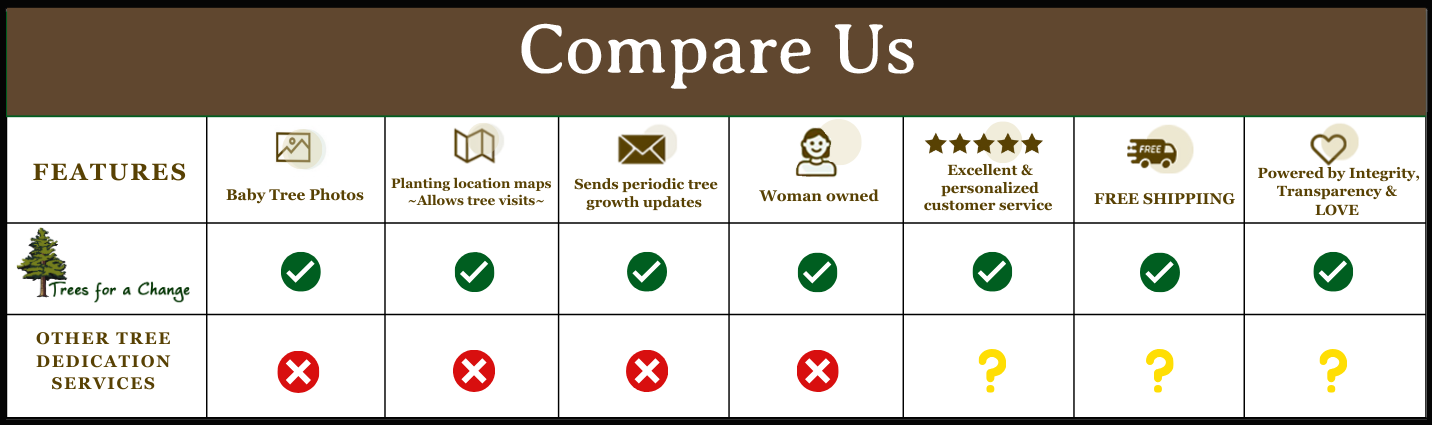
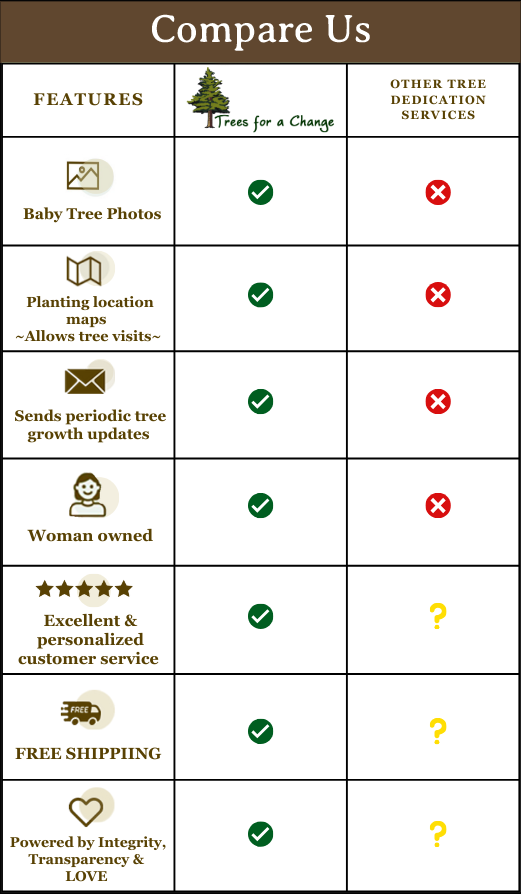
The federal and state funding for the replanting work is scarce, so it is mostly funded by reforestation organizations rather than government agencies. The restoration being done by Trees for a Change makes for a thoughtful gift idea that plants real trees, including giant sequoias. Gift recipients can track tree locations, sign up for tree growth updates, and even visit the tree planting locations if they wish.
They also offer gift trees for memorial purposes that will help forests recovering from wildfire, and tree gift ideas for pet memorials work the same way as sympathy gifts for beloved animals.
Frequently Asked Questions
Are redwoods and sequoias the same thing?
Not the same species. Redwood is a family term covering three species, one of which is the giant sequoia. In everyday use, redwood means the coast redwood and sequoia means the giant sequoia.
Which is bigger, a redwood or a sequoia?
The giant sequoia is larger by trunk volume and wider at the base. The coast redwood is taller. Both hold legitimate world records, which is why the question feels unanswerable.
Are sequoia trees redwoods?
Yes. Giant sequoias belong to the redwood subfamily and are often called Sierra redwoods or giant redwoods. They are just not the same species as the coast redwood.
Are redwoods or sequoias taller?
Redwoods. The tallest coast redwood reaches about 380 feet against roughly 311 feet for the tallest giant sequoia ever measured.
How can you tell a redwood from a sequoia?
Check the needles. Sequoia foliage is tiny scales spiralling around the twig. Coast redwood needles are flat and lie in two rows like a fern frond. Cone size and habitat confirm it.
Do redwoods and sequoias grow together?
Never in the wild. Coast redwoods grow in the coastal fog belt and giant sequoias in the Sierra Nevada, about 200 miles apart. They only appear together in planted collections.
What is a fairy ring?
A circle of young coast redwoods sprouted from the base of a fallen or cut parent tree. Giant sequoias do not resprout this way, so a fairy ring identifies a coast redwood with certainty.
Which lives longer, a redwood or a sequoia?
The giant sequoia. Most live 1,000 to 3,000 years against 500 to 2,000 for coast redwoods, with the oldest sequoia ever counted reaching 3,266 years.
Is a dawn redwood a real redwood?
Yes, it is the third living species in the subfamily. It is native to China, much smaller than the other two, and deciduous, dropping its needles every autumn.
Which is better to visit, Sequoia or Redwood National Park?
Sequoia and Kings Canyon National Parks for record trees on short paved trails. The north coast redwood parks for height and atmosphere. They are seven to nine hours apart, so pick one per trip.
The Bottom Line
Sequoias are redwoods, but redwoods are usually not sequoias. The giant sequoia is the largest tree on Earth by volume and the widest at the base. The coast redwood is the tallest. Both records are real.
To tell them apart, look at the needles: scales that spiral for a sequoia, flat two-row sprays for a redwood. Then look at the ground. Ferns and fog mean coast. Dry open slope above 4,000 feet means Sierra.
And if there is a ring of young trunks growing around an old stump, you are looking at a coast redwood doing the thing that gave it the name sempervirens, which means everliving.
We plant trees for all occasions
Real trees in U.S. National Forests, with maps, photos and growth updates.