

August 28, 2026
Almost everyone uses the word "redwood" to mean one tree. It actually covers three living species growing on two continents, one of which was known only from fossils until the 1940s.
The naming is a mess for a good reason. These trees were classified during a period when British, American, and French botanists were actively fighting over who got to name them, and the argument took 86 years to resolve. (And some of the non-official names are still in common use.)
This guide sorts out the scientific names, what family the redwoods actually belong to, why they are not pines, what California's state tree really is, and where the word "sequoia" came from.
The Three Redwood Species
Start with the structure, because everything else follows from it.

All three sit in the subfamily Sequoioideae, inside the cypress family Cupressaceae. Each occupies its own genus, which is unusual: three genera containing one living species apiece, all that remains of a group that was once spread across the northern hemisphere.
|
Giant sequoia |
Coast redwood |
Dawn redwood |
|
|---|---|---|---|
|
Scientific name |
Sequoiadendron giganteum |
Sequoia sempervirens |
Metasequoia glyptostroboides |
|
Named |
1939 |
1847 |
1941 |
|
Native to |
Sierra Nevada, California |
California and Oregon coast |
Central China |
|
Leaves |
Scale-like, spiraled |
Flat needles, fern-like |
Soft needles, deciduous |
|
Claim to fame |
Largest tree by volume |
Tallest tree on Earth |
Rediscovered from fossils |
|
Other names |
Sierra redwood, big tree |
California redwood |
Water fir |
Sources: International Plant Names Index, Royal Botanic Gardens Kew, and Plants of the World Online.
What the Scientific Names Actually Mean
Sequoiadendron giganteum
The genus name combines Sequoia with the Greek dendron, meaning tree, so it reads roughly as the sequoia-like tree. The species name giganteum needs no translation. Together: the giant sequoia-tree.
Sequoia sempervirens
Sempervirens means everliving or evergreen, which describes both the foliage and the tree's habit of sprouting new growth from its own stump after being cut. Few species names are so well chosen.
Metasequoia glyptostroboides
Meta means after or beyond, so the genus reads as the tree beyond Sequoia. The species name means resembling Glyptostrobus, a related Chinese conifer. The whole name was assigned in 1941 to a fossil, before anyone knew the tree still existed.
That is the strangest fact in redwood taxonomy. Metasequoia was described from fossil material by the Japanese paleobotanist Shigeru Miki and assumed long extinct. Living stands were then found in central China in the 1940s, and the tree entered cultivation worldwide within a decade.
What Family Are Redwoods In?
Cupressaceae, the cypress family. Their nearest relatives are cypresses, junipers, and bald cypress, not the trees most people would guess.
Within Cupressaceae, the three redwoods form the subfamily Sequoioideae. That grouping is old and small. Fossil relatives turn up across North America, Europe, and Asia from the Jurassic onward, which means the redwood family was contemporary with dinosaurs and is now down to three surviving species in two narrow corners of the world.
Are Redwood Trees Pine Trees?
No. This is one of the most common misconceptions about them, and it is worth being precise about why.
Redwoods and pines are both conifers, which means they bear cones and mostly keep their needles or leaves year round. But "conifer" is a broad category containing several distinct families. Pines belong to Pinaceae. Redwoods belong to Cupressaceae. They are roughly as related to each other as a horse is to a rhinoceros: same broad order, different families entirely.
The practical tells are easy once you know them:
-
Pine needles grow in bundles. Two, three, or five needles held together at the base by a small sheath. Redwoods never do this.
-
Redwood foliage is scale-like or flat. Giant sequoia leaves are tiny awl-shaped scales pressed against the twig. Coast redwood needles lie flat in two rows, like a fern frond.
-
The cones are a giveaway. Pine cones are woody with thick overlapping scales. Redwood cones are small and rounded, an inch to three inches at most.
-
Bark differs completely. Redwood bark is fibrous, spongy, and deeply furrowed. Pine bark tends to be plated or flaky.
So terms like sequoia pine or redwood pine tree are common but botanically wrong. The trees are cypress relatives that happen to be enormous.
What Is California's State Tree?
Both redwoods, and the reason is a legislative correction.
In 1937 California named the redwood as its official state tree. The wording did not specify which redwood, and since two native species share the name, that ambiguity sat unresolved for sixteen years. In 1953 the legislature amended the law to cover both the coast redwood and the giant sequoia.
California is therefore one of the few states with two official trees, and given that its pair holds the world records for both the tallest tree and the largest tree, the decision not to choose looks like good judgment rather than indecision.
If you want to stand next to either of them, the accessible groves are spread across two very different parts of the state, and the best places to see both in person are worth planning around, because the sequoia groves and the redwood parks are about 200 miles apart.
The Naming War Over the Giant Sequoia
The giant sequoia has one of the most contested naming histories of any plant, and the fight was openly nationalistic.

Wellingtonia, 1853
After the trees were publicized at Calaveras in 1852, the plant collector William Lobb gathered material and carried it to England. Within days of his arrival, the botanist John Lindley published a description in the Gardeners' Chronicle on Christmas Eve 1853, naming the tree Wellingtonia gigantea after the Duke of Wellington, who had died the previous year.
Lindley had never seen the tree growing.
Washingtonia, 1854
American botanists were furious that the largest tree in the world had been named for a British general by someone who had only handled cuttings. They published a series of counterproposals, including Washingtonia californica and Taxodium washingtonium, and in 1855 Albert Kellogg published Taxodium giganteum.
Meanwhile the French botanist Joseph Decaisne proposed moving it into the same genus as the coast redwood, as Sequoia gigantea. For decades that was the name in general use.
Why every one of them failed
All of them were invalid under botanical naming rules, and for unglamorous reasons:
-
Wellingtonia was already taken. The name had been used in 1840 for an unrelated Asian flowering tree in the family Sabiaceae. Lindley did not know.
-
Washingtonia was also taken. It belongs to a genus of palms.
-
Sequoia gigantea was taken too. Endlicher had already used the genus Sequoia in 1847 for the coast redwood, so the combination was unavailable.
The matter was finally settled in 1939 when John T. Buchholz, at the University of Illinois, argued from differences in seed cone development and chromosomes that the giant sequoia did not belong in the same genus as the coast redwood. He established Sequoiadendron, and Sequoiadendron giganteum has been the accepted name since.
Wellingtonia never quite died. It remains the ordinary common name for the tree across Britain, where hundreds of thousands of them now grow in parks and on former estates.
Where Does the Name Sequoia Come From?
Honestly, nobody knows. This is presented as settled fact almost everywhere, and it is not.
The familiar story is that Stephan Endlicher, the Austrian botanist who created the genus in 1847, named it in honor of Sequoyah, the Cherokee scholar who invented the Cherokee syllabary. Endlicher was a linguist as well as a botanist, which makes the story plausible.
The difficulty is that he never wrote it down. He gave no reason for the name in either publication, and no record survives of him discussing it with anyone. He died in 1849, two years later.
The Sequoyah explanation appears to trace back to an anonymous article in an 1856 farming magazine, several years after Endlicher's death. It was repeated in Josiah Whitney's widely read Yosemite guidebook in the late 1860s and became standard.
A competing explanation holds that Endlicher took the name from the Latin verb sequi, meaning to follow. In a 2012 paper, Gary Lowe argued that Endlicher, working through his own arrangement of the conifers, saw this genus as completing a sequence in the number of seeds per cone scale. Then in 2017 Nancy Muleady-Mecham, working with original documents in Austria, reported evidence supporting a link to Sequoyah after all.
So the honest answer is that both explanations have serious scholarship behind them and the question is open. If you see the Sequoyah story stated as a plain fact, it is being reported more confidently than the evidence allows.
Other Names You Will Run Into
The common names multiply fast, and several of them cause real confusion:
-
Sierra redwood. A giant sequoia. Accurate and useful, since it names the mountain range.
-
Big tree. A giant sequoia. John Muir's preferred term.
-
Giant redwood. Usually a giant sequoia, but occasionally used loosely for any large coast redwood.
-
California redwood. A coast redwood, and also the wording of the 1937 state tree law that caused the confusion.
-
Red sequoia. Not a species. A description of the bark color, which people search for often.
-
Wellingtonia. A giant sequoia, in Britain. A rejected scientific name that survived as a common one.
Do These Species Grow Outside California?
Naturally, barely. Coast redwood extends just into the southwest corner of Oregon, and dawn redwood is native only to China. Giant sequoia grows wild nowhere but the Sierra Nevada.
Planted, they are everywhere. Giant sequoias and coast redwoods do well across the Pacific Northwest, including Oregon and Washington, and in coastal British Columbia. Britain alone has an estimated half a million of them, and dawn redwoods now grow in parks worldwide after seed was distributed following the rediscovery.
The gap between the wild population and the planted one is genuinely startling, and how far each species reaches on its own is worth understanding before assuming a tree in a local park represents a natural range.
What the Wood Is Like
The two California species produce very different timber, and that difference shaped their histories.
Coast redwood is straight-grained, light, and exceptionally resistant to rot and insects thanks to its tannin content. It was prized for construction, which is why roughly 95 percent of the original old-growth forest was cut.
Giant sequoia wood is brittle. Loggers found that felled trees often shattered on impact, wasting most of the trunk. The species was logged, but the poor economics helped end the practice. In an unusual twist, bad lumber is part of why the giant sequoia still exists.
Planting the Family Forward
Three species, all of them narrowly distributed, and two of the three listed as endangered on the IUCN Red List. Taxonomy makes the stakes clear in a way that photographs do not: when a subfamily is down to three living species, losing wild populations is a huge problem.
The Giant sequoia is especially in danger, as somewhere between 13 and 19 percent of all giant sequoias on earth were lost to wildfires in 2020 and 2021 alone.
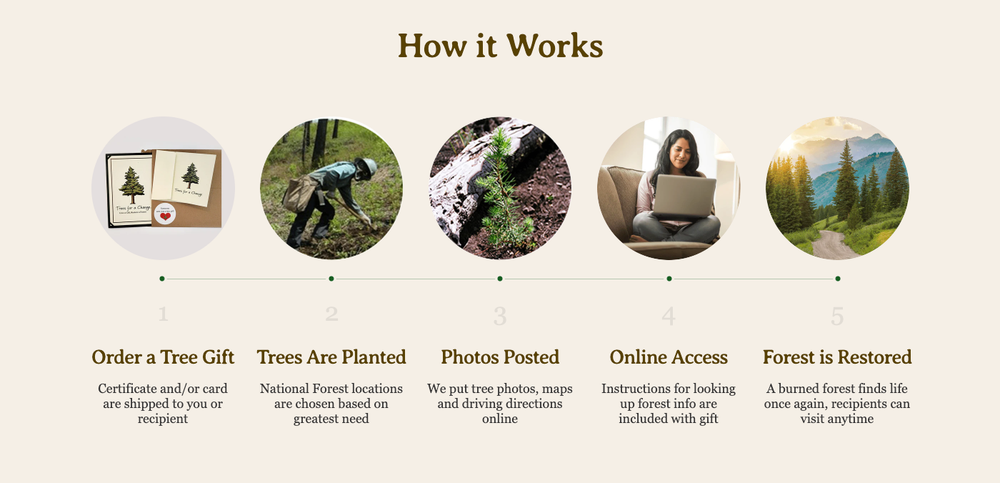
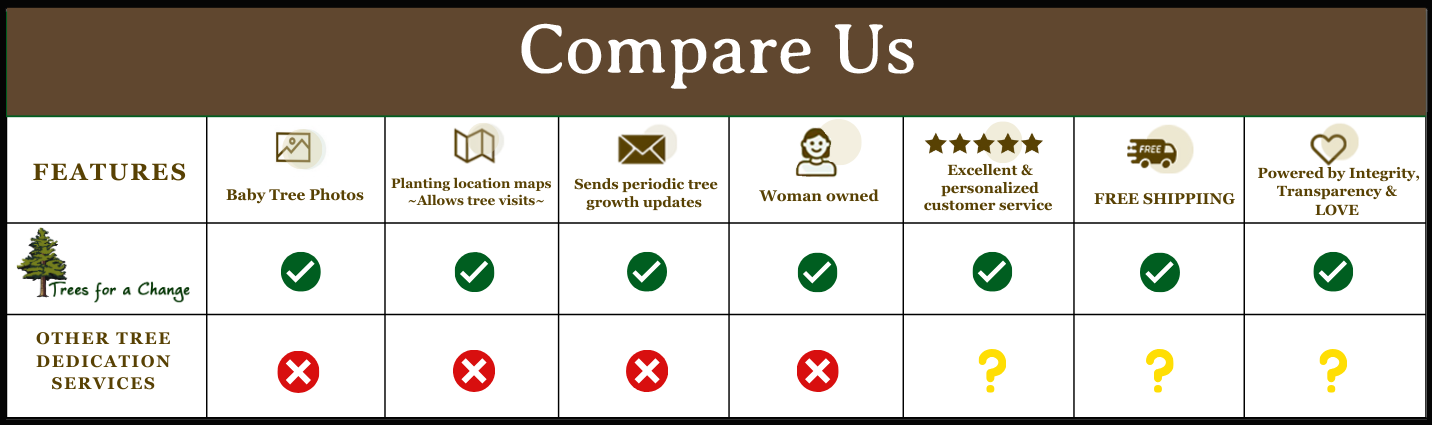
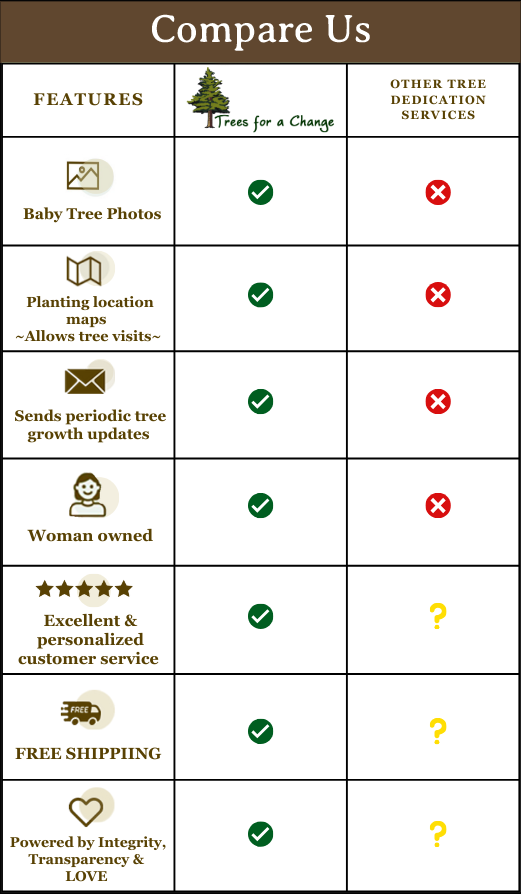
While the loss of these tremendous heritage trees is heartbreaking and to replace them would be impossible, a few organizations like Trees for a Change are working to replant these and other species lost to wildfire. A tree you can plant as a gift for someone goes into National Forest land identified as needing restoration. Trees for a Change then follows up with gift givers and gift recipients by posting seedling photos and planting location maps.
While these tree dedications are a thoughtful gift for any occasion, familiescan plant trees as memorial gifts as a living tribute to a loved one in a recovering forest.
And pet loss gifts that honor their memory give the same kind of comfort to people grieving an animal, which rarely gets the same acknowledgment.
Frequently Asked Questions
What is the scientific name of the giant sequoia?
Sequoiadendron giganteum, established by John T. Buchholz in 1939. Earlier names including Wellingtonia gigantea and Sequoia gigantea were all invalid.
What is the scientific name of the coast redwood?
Sequoia sempervirens, named by Stephan Endlicher in 1847. Sempervirens means everliving, a reference to the tree's evergreen foliage and its ability to resprout from a cut stump.
How many species of redwood are there?
Three living species: the giant sequoia, the coast redwood, and the dawn redwood. Each sits in its own genus within the subfamily Sequoioideae.
Are redwoods pine trees?
No. Redwoods belong to the cypress family, Cupressaceae. Pines belong to Pinaceae. Both are conifers, but they are different families with different needles, cones, and bark.
What is the state tree of California?
Both native redwoods. The redwood was named state tree in 1937, and in 1953 the law was amended to specify that it covers the coast redwood and the giant sequoia together.
Is the sequoia named after Sequoyah?
Possibly, but it is genuinely disputed. Endlicher never recorded his reason. The Sequoyah story dates to an 1856 article published after his death, and some scholars argue the name derives from the Latin sequi instead.
What family do sequoias belong to?
Cupressaceae, the cypress family, and within it the subfamily Sequoioideae. Their closest relatives are cypresses, junipers, and bald cypress.
What is a Wellingtonia?
A giant sequoia. It was the first scientific name proposed, in 1853, honoring the Duke of Wellington. The name was invalid but survives as the standard common name in Britain.
What is the difference between Sequoia and Sequoiadendron?
They are separate genera. Sequoia contains the coast redwood, Sequoiadendron the giant sequoia. Buchholz separated them in 1939 based on differences in cone development and chromosomes.
Which redwood is deciduous?
The dawn redwood, Metasequoia glyptostroboides. It drops its needles every autumn, which surprises most people who plant one expecting an evergreen.
The Bottom Line
Three living redwood species: Sequoiadendron giganteum in the Sierra Nevada, Sequoia sempervirens along the Pacific coast, and Metasequoia glyptostroboides in central China. All three are in the cypress family, and none of them are pines.
California's state tree is both of the native two, settled by an amendment in 1953. The giant sequoia's scientific name took 86 years and an international argument to pin down, and the origin of the word sequoia itself is still being debated by people who have read Endlicher's original papers.
The naming was contested because these trees mattered enormously to the people who found them. What remains is a subfamily reduced to three species, holding the records for the largest and tallest living things on Earth, on a surprisingly small amount of ground.